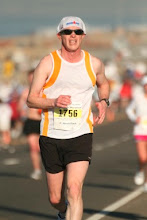
Looking back to my childhood, for a variety of reasons, I never actively participated in team sports. First and foremost, I had asthma. I think that my parents had concerns about my participation in sports. I probably also limited myself out of some fear of exacerbating my asthma. At the same time, I always loved sports. I kept the statistics for my brother’s baseball teams. I would throw the ball against the wall and play “games” by myself. I loved basketball. I read the sports pages and knew all of the statistics. My dad had a brief attempt at running during the “running craze” of the 70’s. I tried to run but got easily winded and never really gave it a go. I was in medical school in 1982 when I saw the Wide World of Sports episode where Julie Moss crawled across the finish line at the Hawaii Ironman. It stayed in my head. When I began practicing as a geriatrician, I would tell my patients the value of exercise. I didn’t want to be one of those doctors who ‘do as they say, not as they do.’ I began swimming and biking and before long, running. By the time I did my first sprint triathlon in 1992, I already had the Hawaii Ironman in my head. In fact, it became my goal to do an Ironman when I turned 40. When 1999 came, despite having done several marathons, work and life precluded me from training for an Ironman. When 2009 came, and I turned fifty, I knew that it was time. As part of my training, I qualified for the Long Course World Championships in Perth, Australia, where I crashed on my bike and suffered fractures of my hip socket, pelvis and clavicle. Six months later I was in the water for a mass start at the very first Ironman St. George. I’ll never forget the excitement of the day, starting with Mike Reilly on the loudspeaker in transition and then calling out, “Michael Wasserman, You Are An Ironman,” at the end of a very long day (http://wassdoc.blogspot.com/2010/05/st-george-ironman-race-report.html). At the time, the 2010 Ironman St. George was one of the hardest Ironman’s ever. I came back in 2011 (http://wassdoc.blogspot.com/2011/05/ironman-st-george-race-report.html) and 2012, trying to continue to improve and challenge myself. The 2012 race to this day is known as the most difficult Ironman race of all time (http://wassdoc.blogspot.com/2012/05/2012-ironman-st-george-race-report.html).
I finally raced in Kona at the Ironman World Championships in 2019 as a Legacy athlete (having completed at least 12 Ironman races). It was a culmination that I thought would allow me to “retire” from Ironman competition. Two things happened. First, I had a really bad sinus infection and wasn’t able to see how I “stacked up” with the best in my age group. Second, they brought back Ironman St. George. I had to sign up! The pandemic not only postponed the race but changed my life completely. Over the last couple of years, I’ve become a stronger runner. So, when the 2022 Ironman St. George became the 2021 Ironman World Championship, it was “game on!” I'm ready!
My race report and how I decided that this would be my last full Ironman follows.
Coming back to where it all started had a bit of a surreal feeling to it. Twelve years ago, almost to the day, I rode the bus to the Sand Hollow Reservoir and tried to “take in” everything about my first Ironman. As I rode the bus today, it was very different. Being my 16th Ironman, the bus ride, when there is one, has become an opportunity to chill and to get “my head in the game,” or to meet other athletes and chat. I sat next to a guy my age from the East Coast. He and his wife and braved a spring storm driving to Utah in their electric car.
While there are always training tweaks that could have been done, I’ve been pretty pleased with my preparation for this race. My swim training had put me in as good of a place as I’ve been in for years, despite the fact that I really didn’t ramp up my swim volume until the last couple of months. Just a week before leaving I swam 5K nonstop at a comfortable pace (under 2 minutes/100 yards). My run training had been exemplary, and I was excited to see how it translated on race day. Ironically, while my run volume over the past six weeks had been less than I’d hoped to do, it still is more than my training volume before most of my previous Ironman races. Also, I really haven’t been concerned about “getting in” run miles, but rather making sure I run close to 10 miles or more on most of my runs. My recent half marathon results (one open, and the other as part of a half Ironman), had only served to boost my confidence.
I had been concerned about a lack of bike volume, and a knee injury that began 7 weeks ago (and two weeks before the Oceanside 70.3) freaked me out until it didn’t. The reason it didn’t was that my bike volume in the final weeks before today was not only solid, but actually felt good. The injury seemed to be related to a strained adductor magnus, and I used KT tape to secure the muscle a couple of days prior to the race. Despite the fact that had still been sore and tender when I arrived in St. George, it seemed to be improving. My head was definitely in the right place as I arrived at Sand Hollow Reservoir.
I immediately went to my bike and put my bottle with 1200 calories of nutrition on it. Then I found the port-a-potties with few lines. I laid down nearby to chill when I saw my coach, Tim, walk by (remarkable with over 3000 athletes). Tim sat down with me, and we chatted about what this race meant and what it didn’t mean. Twelve years after doing my first Ironman, and about to compete in my 16th, I’d often pondered why I did these (my wife certainly wonders the same thing).
When I first started doing Ironman, I think there were a combination of factors driving me. I felt like I needed the incentive of a race to get myself to train. Having a strong history of heart disease in my family, I felt that exercise was important. I also love sports and the idea of competing in a sport as in individual definitely appealed to me. I’ve never been particularly fast, so the endurance aspect of Ironman made sense. Moreover, it was a sport where you can continue to compete as you get older! I’m not sure how much I “enjoyed” training when I started to do these, but over the past few years I’ve realized how much I truly enjoy training. I often say it’s really about the journey. In some ways, the race is “icing on the cake.” In other ways, it’s actually an unnecessary pressure. My coach (who I’ve worked with for 17 years), and I, realized that we’re both in a very similar place. It made for some interesting thoughts as my day went on. Regardless, it was cool to race with Tim! Before I knew it, it was time to line up for the swim start. I poured some water down my wetsuit to help me acclimate to the cold water since we wouldn’t be allowed to get in the water in advance (this actually works).
I’d given a lot of thought to my swim strategy, starting with where to place myself. With 10 people starting together and going off every 10 seconds, two things were clear to me. First, in my age group, my swim pace would definitely be in the upper quartile, which meant that I could start close to the front. Granted, there are swimmers who are still considerably faster than me, so, starting to the far left would keep me safe and allow me a few minutes to work my way towards the buoy line, if I so chose. There would also be slower swimmers from the previous waves in front of me, which would mean navigating them as well, and so heading to the buoy line made the most sense. Obviously, the next wave or two would have faster swimmers catching up, but I calculated that wouldn’t happen until after the first turn buoy and that they would pass me anyway. Besides, there would always be the possibility of drafting off faster swimmers.
Before I knew it, I was in my planned spot on the far left, at the head of my age group. Five, four, three, two, one…and I was off! The water was cold, but I’m used to that, in fact, it felt both refreshing and exciting to get started! Over the first few minutes, I gradually make my way closer to the buoy line. I don’t want or need to have hand to hand combat, and really just want to enjoy the swim, maintain a constant pace and not burn any matches. My swim preparation for this Ironman has been exemplary, and I know that I can keep a solid, yet comfortable effort and pace. After about five minutes, I’m focused on my form and just enjoying the experience. Before I know it, I’m at the first turn buoy, which I swim closely to and head to my right. Shortly after, I’m passed by someone from the wave behind me in a Pearly Gold cap, which I expected. I focus on keeping along the buoy line, maintaining solid form, and keeping my elbows high….no getting punched in the head today! I think about 2012 and the craziness of that swim, and how this is just so nice. I get to the next two turn buoys and start heading back. I really don’t want to use any excess energy on the swim, but I also don’t want to waste time. My form is critical and I really focus on being streamlined in the water and having a good pull with each stroke. As I get close to the final turn buoy, I’m passed by a few people from the wave that started 10 minutes behind me, in Violet caps, I’m on track! The nice thing about the age group wave starts is that I really don’t have many people passing me. They really have to be amongst the fastest swimmers to catch me. I am passing slower people from the waves in front of me, but by this time, I’ve passed most of them that I’m going to pass. I make the final turn and now it’s about 800m to the swim finish. A handful of guys in Green and Silver caps pass me during this last stretch. I just pretend that I’m doing a long swim in the pool and that this time will go by quickly. I do a little extra kicking to get the blood flowing to my legs. As I get to the finish, I’m grateful that I didn’t have to navigate 5 foot swells. I’m out of the water, pulling down the top of my wetsuit and take advantage of the wetsuit strippers. I had planned to put on a mask for the transition tent but decide that I won’t be in there for too long, so I don’t. I’m actually able to comfortably jog to my bike bag, quickly sit down on a chair, put on my glasses, my headband, my aero cycling gloves and then my helmet. I secure the helmet on my head, put my wetsuit and goggles back in the bag, hand the bag to a volunteer and jog to my bike, stopping briefly to get some sunscreen slathered on me. I get my bike, which has my shoes attached to the pedals already, and make my way to the bike start. I put my right foot in my shoe, push off with my left foot and put it on top of my left shoe, pedal a few strokes before reaching down to put my left foot in the shoe. I secure both shoes and I’m off!

My swim time was 1:16:46, my fastest Ironman swim in the last 7 years. 37th in my age group and 1,206thoverall. My transition time was a very quick 6:38.
The first couple of miles on the bike were just to get loose, before coming into a fast descent that went into the first climb of the day, starting with about a half of a mile at 6% grade, very similar to the hill that I jump on every day when I ride out of my neighborhood at home. I was prepared for the opportunity to carry some speed into this climb and cut the climb by about a third, before completing the remaining mile which was more of a false flat. The next several miles were flat, and I actually think I see my coach (after he passed me) at around Mile 10. Turns out it was him! However, I’m patient, knowing that trying to catch him would waste important energy. I’ve begun thinking about how good I felt on the swim, and I start thinking about my discussion with Tim before the race. I begin thinking it might make sense for this to be my last Ironman. I felt so good on the swim, and I was feeling good on the bike. I was doing another Ironman World Championship. There was something that began feeling right about St. George being both my first and last Ironman. On the way back towards the start, we hit the same climb in reverse near mile 15, this time climbing for a little over a mile at ~6% grade.
As I neared the top of the climb, I rode through some beautiful red rocks on both sides of the road. We were riding on the left side during this section. I was feeling good and had been planning to enjoy the golf course off to the side. I never got the chance. As I was looking up the road, a shocking situation played out. I saw a cyclist coming towards me on the other side of the road, and next to him was a motorcycle carrying a photographer. The motorcycle was drifting towards the cyclist. I thought I heard him yell out to the motorcyclist as he tried to move away towards our lane. The motorcycle not only didn’t move away, but kept moving in on the cyclist, finally hitting him, and falling on him pushing them both into our lane. I tapped my breaks and slowed down a bit and was able to avoid hitting them. I briefly thought about stopping, but I was already twenty or thirty yards past them. I’d also seen them getting up as I passed, and I doubted that there was much that I could have done. I told myself to remember to tell someone at the finish about what I saw (but 13 hours later I forgot).
We would be passing by Sand Hollow Reservoir nearing an hour on the bike and reaching our third 1 mile, 5% climb just after passing the Reservoir. All of the climbing that I’d been doing during training paid off as these climbs were pretty routine, and I avoided pushing a high gear, keeping my legs spinning in order to save them for the later serious climbs during the latter part of the bike. The key to this portion of the course was patience. Too early to even consider “burning matches.” Turning onto Highway 9 for a short stretch before turning around and coming back to head towards St. George, beginning with a long gradual descent, came at a great time to recover and focus on holding some speed, before hitting the 2 mile, 3% false flat of State Street. It was really important here to not get too overzealous, and to stay within myself. There was just enough climb to tax the legs if I tried to maintain a fast pace on this stretch. Another short climb on Telegraph would come before a slightly longer climb on Washington Parkway and then the climb on the Buena Vista out and back. All of these were similar to the early climbs and my routine climbing route in my neighborhood, once again reminding me to stay within myself, maintain a good cadence and stay out of higher gears. It would be a long day on the bike and the real riding was yet to come! I also followed my new Ironman nutrition plan, avoiding any calories for the first 45 minutes. I learned this from listening to a Dave Scott YouTube video. I have suffered GI issues for many of my Ironman races, until using this approach in Kona. I hoped it would work again today.

Getting onto Red Hills Parkway was a reminder of the original Ironman St. George bike and run course, and the climb up was yet another 2 mile, 3% slog. Despite all of the climbing on this course, these 3% grades just require patience, and maintaining that patience is easy with the beautiful surroundings. Being in the moment is always the key to a successful Ironman. I remember being thankful on the original course not having to climb from the other direction, with its 4-8% grades, that I would soon be descending, right around the 50 mile mark. I had hoped to get to the halfway point on the bike right around 3 to 3 ¼ hours, which would come right after a short false flat climb past the entrance to Snow Canyon, which I’d be coming back to later for the final climb of the day. Headwinds, probably between 10 and 20 mph, had slowed me down, and I hit the 52 mile mark in 3 ¼ hours. Leaving the thought that I was going a little slower behind me, I took stock of the fact that I felt good, my legs weren’t tired and my hydration and nutritional efforts had left me prepared for the real bike race, which was about to start!
The original Ironman course essentially “started” here, with two loops up to Veyo. I was excited to only do the long gradual climb (1500 feet in 15 miles) once and then to have Snow Canyon as the final climb. Once again, the key was to enjoy the scenery and not get too caught up in the pace. The time will ultimately take care of itself, I think as I climb past Gunlock. A cow crosses the road in front of me. Fortunately, it continues and I don’t have to slow down too much. The time passes and before I know it, I’m turning right and going up “the Wall.” Compared to the final ramps of the Portero wall at home, this actually feels quite doable. I stand for a good part of the climb, but it’s over pretty quickly, leaving a short flat stretch that turns right at the Veyo Pie Shop. It’s such a shame that I can’t stop for pie! There’s one more climb before the long descent. I realize, though, that at this point, the majority of the remaining 30 miles is downhill! This is actually what I’ve been looking forward to. I’ll be able to recover prior to the climb up Snow Canyon, and I can even take that climb pretty seriously. At 4 miles with an average grade of 4.3%, not only doesn’t it scare me, but I’m actually looking forward to it! Seems crazy after nearly 100 miles, but mentally it has always seemed like the appropriately crazy way to view it! What I hadn’t taken into account was the 20 mph winds and the heat, which are slowing me down and sapping my energy.
I’m tired, but my legs are holding up. I’ve kept up my hydration and nutrition, and while I’d planned to attack the climb up Snow Canyon, I’m slogging as I go up the climb. As planned, I take some moments to appreciate the beauty of one of my wife and I’s favorite places. As I near the top of the climb, there are actually more people walking their bikes than riding! Coming off the right turn back to 18, it’s all downhill to T2, and I don’t stress too much to get every second out of the descent. It’s much more important to get into T2 with a low heart rate and taking some opportunity to stretch out my legs and back a bit.
As I get close to the bike finish, I reach down and take my feet out of my shoes, keeping them on top of the shoes. I decide not to execute a flying dismount, no reason to take any chances, and just come to a complete stop at the dismount line and get off my bike. I hand my bike to a volunteer, and after 7 ½ hours in the saddle, am glad to be off the bike. I do take a moment to put on my mask, knowing that I’ll be in the tent for a few minutes. I grab my run bag, sit down, and take off my helmet. I quickly slather some Vaseline on my feet, always a good idea, put on my running socks and slip on my HOKA Rocket X shoes. I put my race belt on and then put my helmet and socks in the bag, put on my hat, stand up, hand my bag to a volunteer, and, after about a 2 minute stop to pee, am ready for the run. I stop for some fluids and some more sunscreen. I put some Vaseline under my armpits (where I typically chafe), and I’m off to the run start. My transition time was 9:06. Solid.
My bike time was 7:36:14, 65th in my age group, 1,881st overall. Nearly 15 miles an hour for 112 miles with 7500 feet of climbing in 90 degree temperatures and 20 mph winds. Lots to be proud of. I will acknowledge that while, trying to ignore how much the bike has sapped my energy, I had been fighting that fact since the climb up Snow Canyon, feeling pain in the bottom of both feet and recognizing it had already been a long day.
My coach always says that the key to an Ironman is to swim easy, bike easy, and run easy, until it gets hard. That’s my goal. I’ve run this course nearly a year ago and am familiar with it. The first three miles are ~1-2% incline, which isn’t bad, but I take great pains not to push too hard. In fact, I start out by walking. There’s a steeper climb right near the start and after I turn left I try to run and realize it’s going to be a harder day than I planned. The primary reason is that my low back is tight, making running more challenging. I’m also “spent.” I start chatting with a younger athlete who tells me that he normally is competitive for a podium spot in his age group, but that he’s completely spent. I feel much better. I see my coach, nearing the finish of his first lap of the run and he tells me how hard the bike was. I’m actually encouraged to know that I’m not alone. I tell him that I’ll see him when he “catches me” later in the loop. I get through the first three miles maintaining a pace of around 14 minutes/mile, and now have about a three mile section with a 1-2% decline. I run, while being careful not to get too ahead of myself, while keeping close to a 10 minute/mile pace. There’s still a long way to go. Keep it easy, until it gets hard, but it’s already hard. I get to the turnaround, and I’ve been consistent. I know that I have about 3 miles of slight uphill followed by ~3 miles of downhill before getting back to the turnaround for the second lap. I alternate walking a running, mostly walking uphill to keep close to 14 minute/mile pace and then my downhill running (and walking now) pace is closer to 11 minutes to mile. I get to the half marathon point and am excited to know that I only have one more lap. I know I’ll finish and I share with fellow athletes how it’s an opportunity to “have a good time,” rather than worrying about achieving a “good time.” My pace continues to alternate between 14 minutes per mile on the uphills and 11 minutes per mile on the downhill sections. But I’m really feeling tired and my back continues to be tight. At mile 19 I start walking with another athlete who turns out to be a cardiologist from San Diego. He’s 40 years old and has done 20 Ironman’s for the “Fuck Cancer” philanthropy. We actually have a mutual friend. He’s also normally faster. I decide that this is a great opportunity to rest and relax and not worry about my time. We see athletes on the side of road puking. It’s truly carnage. This course has humbled a lot of people. My pace slows to about 17 minutes/mile for the next few miles as I decide to just enjoy the company of a fellow athlete. I actually manage to run mile 23-25 at around a 12 minute pace. Still, it’s hard. It’s windy. I’m tired. My back still hurts. So I walk until I get to the finishing chute, where, as always, I have wings and energy to the finish line waving my arms in the air to get the crowd to cheer. I stop at the finish line and raise my right hand showing four fingers to represent the four St. George Ironman’s that I’ve completed. There were only 26 people who completed the first three, and I’m sure there’s a lot fewer who have now completed all four.
My run was 5:54:53, 48th in my age group, 1676th overall. 2,294 people finish the race, with nearly 3,000 starting. Another St. George Ironman with a high DNF (Do Not Finish) rate. My finishing time is 15:03:35, my slowest Ironman finish time on arguably the hardest course in the world. That puts me 53rd out of 90 men in my age group who finished (there were nearly 150 signed up, and probably closer to 110 who started). I’m 1,714th overall out of 2,294, keeping in mind that hundreds of people didn’t even finish (they’re not counted in the results). I’ve definitely acquitted myself well in the Ironman World Championship!
My mind was made up early in the race, and it hasn’t changed at the end. Good result. Bad result. In between. I love the training. The race, the medals, aren’t why I do Ironman. The idea of swimming, biking and running based on how I feel on any given day, appeals to me. Ironman races also take a lot out of you. My wife reminds me that I get depressed after my races. She’s right. My coach made a great comment to me this morning, which was that the pressure of “having” to train because you have a race ahead, is an unnecessary distraction from the enjoyment of training. I get it! That same pressure also impedes one’s time for other things, including family, which is my number one priority. Furthermore, training builds you up. The training is every day. It’s the life I enjoy and want to continue to enjoy. It’s really what defines me now. Not only don’t I have anything to prove, I want to truly live my life in the moment. I also no longer have a need to “prove” my ability in an Ironman World Championship. At the age of 63, I just finished the hardest Ironman in the world for the fourth time! There isn’t a better time to step away from racing full Ironman’s. I look forward to training “in the moment” for the rest of my life. Afterall, I often say that Ironman is a metaphor for life. Maybe now I’ll say that life is a metaphor for Ironman.