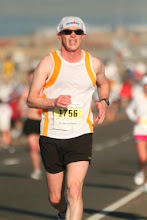
Whether doing an Ironman, living one’s life, or running a business, it’s about focus. As I begin my journey over the next 35 weeks this is probably the single most important thing I will need to remember. One week ago, out of the blue, I decided that I was going to try to run every day. Now, for someone my age this normally wouldn’t seem to be the best idea. In fact I would attribute the fact that I have had very few running injuries to the fact that I don’t run every day. On the other hand, running every day doesn’t mean running a lot every day. It’s always a matter of degree. So over the last week I did run every day, and I managed to put in over 10 hours of total training last week, which included about 20 miles of running. This morning I got up, went out and ran a little over 2 miles. It’s not the distance that matters. I think that running every day puts me in the proper state of mind. In order to achieve the goals I'm setting for myself, this is important!
This morning was interesting for another reason. I woke up a little early, but not in the middle of the night, which I had been doing for sometime. Sleep pattern changes are one of the signs of fatigue. So waking up a little later than usual and actually being able to go back to sleep a couple times without any problems and getting my full nights sleep was a big deal. But that wasn’t the best part. I'm someone who tends to remember my dreams. I’m also someone who takes whatever is bothering me and finds a way of dreaming about it. Needless to say, over the last few months my dreams have not necessarily been the favorite part of my night, as I've struggled with a number of things in my life. This morning I woke up and realized that I had dreamt about the Snowdrop ultra (the 100 mile run/walk that I did over New Years). And, it was all good. I dreamt about the people, the camaraderie, the positive feelings I had doing this remarkable event. I don’t know what this portends in terms of whether I will do it again, but I do know that I can rest well with this recent accomplishment. Perhaps, it’s also a message that it is time to move on to my next goal.
This brings me back to the concept of staying focused. I’ve always been someone whose mind is going in many directions. In fact, if I was born today I would probably be labeled with ADD. When I have a job, it gives me something to focus on and I generally don’t have any problem doing that. When I have multiple choices to make in terms of what I want to focus on, that is when I can run into difficulty. This brings me back to my Ironman training and why the idea of running every day, sometimes just for a mile, is important for me to latch onto. I think it’s also a chance first thing in the morning to get my brain focused on all of the other tasks at hand, which includes a major project I'm working on. And so, I must learn to tamp down my habit of going in multiple directions at one time, which is easy to do at this moment in my life. I think the other key to successfully staying focused will be to avoid being distracted by other things such as politics, news and empty social media. I realize, especially when there is too much time, with too little structure, today's world of instantaneous connectivity might not be the best thing for me. And so, everyday I'll get a run in and work on being focused.
Monday, February 4, 2019


Sunday, February 3, 2019
Journey to Kona Day 1
February 1982. I loved sports and regularly watched Wide World of Sports. ‘The thrill of victory, the agony of defeat.’ I was 22 years old and a first year medical student. I had never run a full mile in my life, having grown up with asthma and believing that I had limited athletic abilities. Yet, as I watched Julie Moss cross the finish line of the Ironman, something clicked. This was something that I wanted to do someday. In retrospect, what clicked was a connection to who I was as a person. I was someone who would always set the bar higher than what seemed achievable. I also intuitively knew that reaching that bar was not the true goal. The goal is the journey itself. There have been times in my life that I’ve forgotten this, though rarely in my athletic endeavors. Recently, in my life’s journey, I set an impossible bar and subsequently struggled emotionally with the consequences of not reaching it. Perhaps that is why my 37 year journey to compete at the ironman in Kona has taken on a greater meaning and purpose. It’s a way of coming back to the balance point that I’ve always wanted to define myself by. In 35 weeks, I’ll be at the start line in Kona, competing at the Ironman World Championship.
Life kept me from my ironman goal until I realized that I couldn’t put it off forever. My first ironman was at the age of 50, and I completed it just 6 months after breaking my clavicle, hip socket and pelvis in a bike accident. While the idea of qualifying for Kona was always in my head, the reality was much starker. The Legacy program gave me a new goal of completing 12 ironman’s and ultimately getting to Kona that way. I’ve got my “ticket” to Kona this year through the Legacy program, but my self-competitive nature will not rest on that. I have to make the most of this opportunity. Crossing the finish line this October in Kona feeling anything less than having given it my all won’t feel right. It’s not how I’ve raced the majority of my ironman’s and it’s not how I’ve approached my life. I want this year’s Kona experience to build on how I felt at Ironman Boulder in 2016.
Three years ago I set out to complete a twenty mile run every week for twenty weeks. I did this for a couple of reasons. First, because the 20 x 20 concept sounded cool! Second, because ultimately, if I was to ever achieve a qualifying spot for Kona in my age group, I would need to have a good run. Looking back, I approached my 20 x 20 goal after a really rough year. I had signed up for three ironman’s in 2015, and only raced in one (didn’t start the first due to back problems, and the third one was cancelled due to a hurricane). My body, however, had been tired in 2015, as most likely was my mind and emotional self. Over the course of 20 weeks, the 20 mile run went from feeling hard to feeling routine. I’ll never forget that after 15 weeks I began to think about my next goal! In retrospect, my swim and bike training were nothing spectacular, which made my performance at Ironman Boulder in 2016 all the more remarkable. My swim was ok, although several minutes slower than what had been my average ironman swim time. My bike was solid, only the second time ever that I biked under 6 hours, and the first time I’d never felt any “doldrums” on the bike. I came off the bike 17th in my age group, and just focused on running. It was a hot day and while I slowed down towards the end, I kept running. When I finished, I was spent, and literally lied down and couldn’t move for 45 minutes. I had run to 6th in my age group! One place off a podium position, and 45 minutes from a Kona qualifying spot. More notably, my time would have won the 60-64 year old age group that I was three years away from.
So here I am today. 35 weeks from competing in Kona. I want to represent myself well. I want my ultimate goal to represent who I am as a human being. I’m not going to Kona just to finish. I’m going to prepare myself better than I ever have and then I’m going to do what I usually do, give it everything I’ve got! Until this past week, I wasn’t sure how this was going to play out. Over the past year and a half, my training has dropped off dramatically. I’ve also been through some of my most emotionally trying experiences. It’s time to focus. Over the past week, I’ve run every day, and I’ve finally got back on my bike after several months away. I can feel the cobwebs loosening and my resolve returning. I also think that I need to capture every day of this journey, which is what I’m starting today!
Wednesday, May 16, 2018
Ironman Santa Rosa Race Report
When I got off the bike at this year’s Ironman Santa Rosa, my legs felt dead, but I figured that I could walk for awhile, make sure I was nourished and hydrated, and run the rest of the way. This is what I had done at Ironman Chattanooga a couple of years ago when I got dehydrated at the end of the bike ride. The difference was that I was training 10-15 hours a week at the time. For the past six months, I’d been training 4-8 hours a week, and almost 30% of that was my new found strength training. I had paid close attention to nutrition and hydration on the bike, and was actually able to eat pretzels and oranges and drink water at the beginning of the “run.” My GI tract was fine, but my legs didn’t have “it.” It might have had something to do with minimal run training over the past six months. And, minimal bike training. And, minimal swim training. So, I literally walked 26 miles, there were some 2-3 minute attempts to jog/run throughout the first half. But, ultimately, I came to grips with the fact that I just needed to finish and there was no reason to push, as I had seen others do over the years. Trying to maintain a 15 minute/mile walking pace was really the goal, and not to see it slip to the 20 minute/mile ironman shuffles that others who push too hard ultimately fall prey to. The cool thing was that when I finished, my run pace was almost exactly 15 minute/mile. Something to remember for the Ultra run I have planned with my friend Robert Key over New Year’s. I also met and walked with four other people throughout the course of the run, keeping myself occupied and making some new friends.
How did this race come to pass? Last July, I completed my 12th ironman, in Santa Rosa. That was the race that qualified me for the Kona Legacy program. It was also my least favorite ironman experience, as I had a full blown cold on the day of the race. In retrospect, having something to compare that experience to, I am even more impressed with what I accomplished that day. I had my best bike split ever, and managed to run for 2/3 of the run. I followed up Santa Rosa four weeks later with my second 50K Trail race, where I got dehydrated during the second loop, but still managed to complete in a reasonably good time. My life also changed completely around the same time, when I unexpectedly became the CEO of the largest nursing home chain in California. Work:Life balance has never been my strong suit, and the coming months would test me severely in this regard. Fortunately, my coach, Lucho, has maintained positivity throughout this whole time. After all, I can only do what I can do! I actually found a strength and conditioning coach, Will, and have been working with him since October. I’m stronger than I’ve ever been, especially with my both upper body and core strength. I’ve also gained about 8 lbs, mostly muscle.
However, as I noticed previously, my 10-15 hour ironman training weeks dropped precipitously to 4-8 hours a week. 1 to 3 of these hours were spent in strength and conditioning training. That doesn’t leave a lot for running, biking and swimming. I’ve never been one to push the swim training too much, as my form has kept me in a reasonable ironman swim range. However, my ironman swim times had been dropping from an average of ~ 1:12-1:15 to 1:20-1:25. At the end of the day, doing the math of increasing swim training to maintain my previous paces, still didn’t make a lot of sense. Saving 10-15 minutes on the swim might take 2-3 hours a week of extra swim training, those hours would be much more beneficial on the bike and run. I had also noted that the strength training was also supporting my swim. My run had really struggled, partially due to an ongoing problem with my piriformis muscle since last fall. It was affecting my back and my glutes, and I had continued to struggle. Hence, very little running, but in the 4-6 weeks prior to this race, I managed a couple of 3 hour runs (about 15 miles), and felt like I was capable of doing the ironman run. Probably wishful thinking, considering my “20 by 20” experience a few years ago. That’s going to come back soon! I had also managed a few long bike rides, the longest being 81 miles with 10,000 feet of climbing (7 hours in the saddle) just three weeks ago. Of note, these long rides were all done on my road bike. Hence, very little time in my aero position on my triathlon bike. I figured that I’d really focus hard on nutrition and hydration during the bike portion of this event. I didn’t really think too much about the impact of being in the aero position for 5-6 hours. Of note, my strength and conditioning work did still help me to do this, but not enough.
So, here I was, 10 days before Ironman Santa Rosa, in Orlando for the Annual meeting of the American Geriatrics Society, working 14-16 hours a day, when I came down with a cold again! On a positive note, I was three days into the cold, which was it’s peak, on the flight home from Orlando, when I realized that last year I’d done an ironman feeling exactly like I did that day. I was only going to feel better a week later. Of course, I had to work during the week, and even made my drive to Santa Rosa a working day, visiting three of our nursing facilities on the way. How does one spell Type A Workaholic?
Race morning came, and I actually was nearly over my cold, just a little nasal congestion, but I felt fine otherwise. The morning of an ironman has become fairly routine for me. No nervousness, generally just enjoying the experience. Santa Rosa involves about a 30-40 minute bus ride to Lake Sonoma. Then it’s a matter of making sure my fluids and nutrition are on my bike, my tires are adequately pumped up (with rough roads ahead, only had my tubular tire pressure at between 100-110 psi, low for me, but might have gone lower), adequate time in the porta-potty, and getting my wetsuit on. I had a brand new wetsuit, a Blue Seventy Helix, which I think I finally got the size right. Previous wetsuits might have been too tight and constricting, leading to some back spasms. The Helix also zips down, so I needed someone to help me get the zipper pulled together, but that wasn’t a problem. It was a beautiful day, water temperature of 68 degrees and before I knew it, was making my way into the water in the new format of a rolling start. In fact, they had people going into the water 5 at a time, in intervals of every 5 seconds. This makes the entry into the water less combative. The swim course is a two lap course, so you come out fo the water briefly after the first lap. I just got into a comfortable rhythm, occasionally drafting off of someone else, but generally not paying too much attention to that. I also tried hard to follow the buoy line, which I felt that I did. The swim never felt hard, I actually focused on just enjoying being in the open water. I had minimal jostling, never got hit in the head and never actually swallowed a mouthful of water (had a few near misses). All in all, an uneventful swim. It was also my longest ironman swim ever, at about 1 hour and 30 minutes. It also turned out, by my garmin, to be my longest ironman swim ever, at about 4600 yards. My pace was about exactly the same as the year before, but I swam farther this year. All in all, I’d like to have been ten to fifteen minutes faster, but not a big deal in the scheme of an entire ironman.
When I came out of the water I felt pretty good, not great, but certainly not tired. The walk from Lake Sonoma to the transition area is about 1/4 of a mile and steep uphill, so I just walked. I stopped very briefly half way up for the wetsuit strippers, got to the top, got my bag, made my way into the tent and put on my aero cycling gloves, my glasses, my headband, my shoes and my helmet, locked my visor on my aero helmet into place, put my wetsuit in the bag and dropped it off at the front of the tent, got sunscreen slathered on me and walked to my bike. This year I remembered the immediate hill after mounting my bike and had my gears at their lowest level. After crossing the bridge, there is a long downhill that you’re not allowed to be aero for, so began some fluids, and just getting comfortable. No pressure, just took it easy. That would be my theme for the bike today.
I had most of my nutrition on my bike, 400 cal of Tailwind in my aero bottle (between my aero bars), 200 cal of Tailwind with water in the downtube of my Shiv, and 800 cal in a bottle to use to replenish. I also had 400 cal worth of almond butter. Over the course of the bike, I ended up added some bananas and some gatorade. In all, I took in about 2000 cal, which was my goal. I drank water the whole way and stayed hydrated. I wasn’t able to pee during the ride, but felt like I needed to and definitely did in T2. Last year’s bike course was a PR for me, despite my cold, coming in at 5:47. This year, they changed the course, adding more hills and a few more climbs. There were complaints last year about road conditions along a few sections of the course. Be careful what you wish for. Last years course had a few miles of terrible roads. This years course had many miles of relatively rough roads. For someone who had spent no time in their aero position for the last six months, this would prove to take it’s toll. I realized about half way through the bike that my neck and back were tight. Fortunately, my core strength probably saved me this time around, because it wasn’t too bad. I never looked at my power, and it turned out to be about 5-10 watts lower than last year, but I also really focused on taking it easy on the bike. I never felt like I was pushing too hard. The two climbs up Chalk Hill didn’t feel like hard climbs. I got to Mile 50 in 2:45, which would have put me on target for about a 6:10 bike time, which is pretty close to my standard time based on the type of course this was. What happened, and I had predicted (looked at windfinder.com) was that at around Mile 50, when we turned north again, the headwinds would start and pick up and would never end. The headwind followed us all the way to the finish and got up into the 15-20 mph range at times. By Mile 80-90, I began looking forward to finishing, which is fairly normal for me. With that said, I never felt bad during the bike, but by the finish I was pretty well spent. The constant relatively rough road conditions took it’s toll on the mind and body, as did the constant headwind. I came into town, pulled my feet out of my shoes and dismounted in my bare feet. While it never got above 80 degrees during the race, the asphalt on the way to T2 was hot. In retrospect, I should have kept my bike shoes on, because I did burn the soles of my feet a bit. Not too bad, probably noticed more after the race than during.
I walked to T2, knowing that I was pretty tired. I had already decided to walk most of the first mile and see how I felt. So, I took my time during T2, put vaseline on my feet, put on my shoes and my hat, and used the porta-potty. Both of my transitions were about 8 minutes long each, which is actually very solid. I got more sun screen slathered on me and made my way onto the run course. I immediately knew that I need to walk for awhile. What I didn’t know was for how long. That’s the crazy thing about ironman. Sometimes the light goes on and you can run again. On the other hand, I pretty quickly decided that there wasn’t really a point to running much today, insofar as I’d feel better in a few days with less running. I also didn’t want to push it. I’d already been awarded my Legacy spot for Kona in 2019 and all I needed to do was finish. Getting off the bike in one piece was the key. I could make it the next 26 miles. I had been a little concerned that this was my 13th ironman and that I could have had a flat tire or something, especially on this course, with all it’s potholes. But, I had dodged all of the bullets there. Now it was just a matter of making my way around the 3 loop run course.
The first friend I made was Robert, who was doing his ninth ironman in three years, having lost close to 100 lbs in the process of turning his health around. He was wearing a knee brace, so I quickly surmised that he would be good to walk with. I was impressed with his story and he made for a good walking companion for awhile. However, he was slowing a bit, and I wanted to try to run a little, so I pushed on and met Cody, who was in the 20-24 year old age group. He had hoped to finish in under 9 hours, but had blown a hole in his tire on the bike and walked 10 miles in his bike shoes before getting a new tire. Needless to say, his legs weren’t in the best of shape. It turned out, however, that he had only taken up triathlon 2 1/2 years earlier, having never been much into running, cycling or swimming. He had already qualified for this years ironman world championship in Kona, and had hoped to be competitive for a top spot in this race. I’m not sure why he didn’t just DNF, but I give him credit for persevering. In the end, he went ahead and ran some, but we caught him again on the last lap and actually went ahead of him. Another example of how trying to run when you shouldn’t leads to a much slower walk in the end! I walked most of the second half with Patrick, who was from Orlando, where he runs the food and beverage division for the Gaylord. I got to pick his brains on the industry, which is of keen interest to me since my kids own a restaurant. Finally, with two miles to go, I met Luis Alvarez, who is an ironman legend in his own right. When TJ Reilly and I were at the start line of the inaugural IM Chattanooga, the announcer told us of two guys who had flown that night from IM Majorca (in Spain), to participate in Chattanooga. Two ironman’s in two days on two continents. Luis was one of those two guys and this was his 153rd ironman. I also learned that he’d climbed Mount Everest, and was blinded on the way down, having now recovered about 85% of his vision. He used to own and run three companies, but sold them and was now “retired.” And I thought I was a workaholic!
It’s always remarkable to get to finishing chute of an ironman. No matter how you’ve felt, no matter how beat up you are, suddenly, you have wings and a ton of energy. I encouraged the crowd to cheer for me and crossed the finish line in 14 hours and 51 minutes, my slowest ironman ever. In many ways the walk was interminable, but at the same time, it was part of the journey. One thing is for sure, when I do Kona in 2019, I will be well trained. I have to say that doing an ironman without proper training is doable, but is much less “fun.” When I got into this sport 25 years ago, competing at Kona has always been in the back of my mind. In fact, I think it has been on my mind since watching Julie Moss crawl across the finish line in 1982. I want to soak up and enjoy every second of the Kona experience when I go there, and in doing so want to give the experience the justice it deserves. That means being prepared to the fullest extent possible! I have 17 months to prepare. The first part of my preparation, after a few weeks of significant rest, will be to build my running fitness to join my buddy, Robert Key, at the Snowdrop 55 Ultra on December 30th. This will be my first and only attempt at completing 100 miles in approximately 24-30 hours. After that, the bike and swim training will commence for Kona, and I will have next summer to nail my preparation. As always, I have my coach, Lucho, to thank for his support and encouragement. He never said anything negative about my lack of training going into this race, because it wouldn’t have changed anything. In fact, he was still very positive about my result, especially as it related to my paucity of training. I’ve been fortunate to have such a great coach for 13 years! It looks like this should be my last race report until October of 2019!
Monday, February 5, 2018
Single Mindedness
Single mindedness. That’s the word that comes to mind in describing an experience I’ll never forget. It really began at the beginning of a very long and complex work week. My days were running 12-16 hours and there were a number of highly charged and complex issues that I was dealing with. I rarely use the word stress to describe work, because I love what I do and always appreciate a challenge. I had started my day in Redding, California and was making my way to Eureka via Route 299. While the route was simple, I still use the map feature on my iPhone as I always do, because it synchs with my apple watch so I don’t have to take my eyes off the road to look at it. I was about half way into my drive, about 2 hours, when my apple watch vibrated. I pulled over and realized that I’d missed a turn. It seemed odd that the map feature was taking me off the main highway to Eureka, but there had been a number of rock slides and construction work during previous drives, so I assumed it was detouring me around something. I did a u-turn and turned right onto a country road. Immediately, I had to cross a one lane bridge, and then I started up the road. It wasn’t long before I realized that this road really only fit 1 car, but there were no other cars that I’d seen (nor any other signs of civilization for that matter). The Map feature told me that I had 4.5 miles to go before turning, and I assumed that would bring me back to the main highway. Up and up the mountain I climbed, winding around in the forest. Near the top of the climb I passed a police car near another car that seemed stranded in the middle of the road. Odd, I thought, but drove on. I saw a few patches of snow on the side of the road, but figured I was about to get to the turn and head back down. I made it to the turn, and the Map feature told me to turn on another road, which I did. As I made my way downhill a ways, the Map feature started saying that it was rerouting me. I figured that since there was no cell coverage that it just wasn’t connecting. I made my second assumption that this had been taking me in the right direction, so I should continue on. I actually passed a couple of cabins before I started climbing again. I passed some trees that had fallen and been cut so that cars could pass. I started seeing snow again on the side of the road.
One might ask, why did I keep going? I was actually starting to feel a little anxious that this might not be the right direction and that perhaps I should turn back. I didn’t, and I hit a few patches in the road where there was actually snow on the road, but previous cars had marked out a clear path. I figured that this must still be the right way. As I write this, I realize how single minded I had become at this point, absolutely focused on continuing forward. I was gripping the steering wheel, getting an uncomfortable feeling in my chest (where I feel most of my anxiety), and was definitely sensing potential danger. There is no question that if my wife had been with me, we’d have turned around and gone back miles ago. My tenacity and single minded focus on moving forward kept me driving up the road. I hit a patch of snow and ice that made me a little nervous, but I got through it and the road cleared. I assumed I was getting close to the top of the mountain, based on looking ahead, when I turned into another stretch with snow on the ground. As I drove a little further up the hill, my car started to struggle with the snow and I slowed down. This wasn’t a good idea, maybe I should back up. I put my car in reverse and before I knew it, I had backed against the side of the road and wasn’t moving.
Anxiety now made way for a sense of full on panic. I jumped out of the car and frantically tried to shovel snow with my hands in front of my front and rear tires. I got back in the car and tried to move forward. No luck. I got out again and realized that a tree root was caught in my right front wheel. I wasn’t going anywhere. A little more panic set in. I could feel the discomfort in my chest grow. My brain wanted to think about how stupid I had been to get in this situation. But then my brain went back to 2012 and Ironman St. George, where I was stuck in a reservoir with 50 mph winds and 5 foot swells. I had swallowed water and my calf had cramped. That was actually a more dangerous situation. I knew that panic was not going to get me out of here. I looked at my watch and realized it was 1:30 pm. I knew that I was approximately 15 miles from the main highway. It was up and down, but I was an ironman, I could do this in my sleep. It didn’t help that my right glute and left low back had been tight recently, but so what? I put on my running shoes, a lightweight jacket and took my one bottle of water. I set off down the run at an easy run. While downhill running has it’s advantages, it’s also hard on the quads. I got to the base of the climb, where a few cabins were, but there were no people there. I kept going, figuring that I’d gone about 5-6 miles already. I kept checking my cell phone and my apple watch and tried calling 911, but to no avail. There was no coverage. I walked some of the steeper climbs, noticed some signs warning of bears, and occasionally asked myself how I’d gotten myself into this. Each time that happened, I remembered St. George and my coaches mantra of staying in the moment. Reliving how I’d gotten myself into this wasn’t going to help me. I had to put one foot in front of the other and move forward. I’d occasionally come upon some snow and ice patches and was very careful. Slipping and falling might lead to being stranded in the middle of the forest with nightfall approaching. Not a good thing. I figured that I was about 9 miles into my run/walk when I saw a car approaching ahead. I immediately began waving my arms and a guy in a pick up truck with a dog slowed down and stopped. He had on a baseball cap and had the look of someone who lived in the forest off the grid. A chainsaw was on the floor of the front seat. The first thing he said was “GPS.” He told me that this happened to people all the time, and that no one had done anything to fix the problem. He was also a little irritated, as it turned out that he’d just come from a lawyer dealing with someone trying to evict him from the land he was living on. He also told me that he’d helped countless people and few of them, if any, were appreciative. I told him that he’d lucked out. I wasn’t that kind of person. Also, I knew some of the best lawyers in the country, and that I would forever be in his debt if he helped me. He relaxed as he drove to his home in the forest, back in the direction that I’d just come from. He had to get home to call his attorney about the matter they’d been working on. Could I wait before going to see about getting my car unstuck? Of course?
During our drive, he told me of the 80 year old who’d been stranded, the couple with two kids, the guy who got frost bite on two fingers. I was not the first person to follow their GPS to nowhere. And, it was nowhere. If I’d even managed to keep going from where I got stuck, the conditions would have only gotten worse! We got to his home in the forest and he fired up his generator so that I could hook up to the internet. I guess he didn’t live totally off the grid. There was no cell coverage anywhere along the road. My son-in-law had texted me that we should think of going to the snow with my grandson. Little did he know. I texted a few people so that they would know where I was and that I was safe. I didn’t let my family know, as I didn’t want them to worry until I was safely back on the road. I used an incredible outdoor latrine with a view of a creek. Soon we were driving up the mountain to my car. I once again asked myself, how in the heck did I keep going? Why didn’t I turn around? I guess it’s that single-mindedness. However, that same single-mindedness saved my life. I asked him about the bears, he said that they don’t bother people. On the other hand, he said, the mountain lions are a different story. Yikes!
As we got close to my car, his pickup struggled to stay steady on the road. He put it in a lower gear and we got to my car. His chain-saw came in handy as the car was stuck on the tree root. I shoveled in front of the tires and then a ways up and down the road to form a path. So, a 90 minute hilly run and some snow shoveling, a pretty solid workout for the day! I was able to get my car moving forward and then put it in reverse to back down the road about 100 yards and out of the snow! I thanked my new friend for saving my life and headed back to the highway. As I drove to Eureka, I began to realize how close I came to any number of bad outcomes. Again, I put those thoughts out of my head and kept my focus on staying positive. Hopefully, I can maintain my single minded focus on the things that matter the most!
Monday, August 28, 2017
Bulldog 50K
I rarely write a race report for a pure running race, but this one was epic. I had done Ironman Santa Rosa four weeks ago and decided to use that fitness to do a 50K trail race. I’ve done the Bulldog 25K three times before, and had done the reverse course as a 50K about 4 years ago in a driving rainstorm (more of a muddy slog than a running race). I was planning to use this race as training for a 50 mile trail race in October (more on the later). As usual, or so it seems lately, life dealt me a series of challenges over the last couple weeks, but it didn’t really matter because i was recovering from Ironman Santa Rosa (and Boulder prior to that), and really never did much running in the intervening 4 weeks. Still, I felt good coming into this race and got a good night’s sleep the night before, actually too good! I had earplugs in and slept through my alarm! I literally had to get up and immediately drive to the race, forgoing my usual morning routine, which always includes some cleansing of my colon (no one ever talks about that, but all of us athletes know the importance of this usual bodily function). I got to the race with some time to spare, but never really completed this part of my pre-race routine. There were no port-a-potties on the course, so managing my nutrition just got a little more critical. I decided to stick purely to liquid for the race.
I had my new Nathan vest with two bottles in it, which I had pre-filled with 100 cal of Tailwind Nutrition each. I had also frozen them overnight and they were providing some good cooling at the beginning of the race. I had also filled a plastic bottle with Tailwind and planned to carry it for awhile. This extra bottle ultimately carried a good deal of importance. The race started and I just set out at a comfortable pace. The first mile is flat and I found myself running it right about 9 minute pace. The next mile included a hill, which I walked. I had set out to walk all of the climbs on the first loop of the course, and I was going to be disciplined. The third mile had a good deal of rocky singletrack, which I took carefully, no need to trip and fall early in this race. I passed the MASH set (yes, that’s where this course runs by) and got to the first aid station feeling good. I had drank my plastic bottle full of Tailwind, saving the Nathan bottles for the climb. I took in some extra water and gatorade at this stop and immediately headed up the infamous Bulldog climb.
I read an article yesterday about the Bulldog climb. By my garmin, it’s 3.2 miles with 1750 feet of climbing. The author of the article stated that GPS in inaccurate on this climb, so I’ll choose to believe him in order to enhance the epic nature of the day. Perhaps the climb is as long as 3.5 miles and has up to 2000 feet of climbing. The temperatures were already in the mid 70’s by the time we hit the climb. The average incline is 10-11%, with pitches up to 20%, the worst of which occur towards the top of the climb. I power walked the whole way, except for short stretches where it flattened out, which I ran, and my pace was ~16-17 minutes/mile, which is pretty close to what I’ve done up this climb in the past. I did the climb, according to strava, in 53 minutes, slower than my fastest time running the climb all out by about 10 minutes. Not bad, however, considering that I had a full 50K to do.
When you reach the top of Bulldog, there is about a mile downhill on a fire road. The rains this past winter has made most of these roads rocky and the footing was not easy. With my propensity to trip and fall, I was careful, a pattern I’d follow all day, which kept me safe, but also slowed me down. I arrived at the second aid station, and had drank my plastic bottle of fluids, as well as one of the Nathan bottles. The rest of the loop is not downhill by any means, in fact, it seems like there are more and more climbs. The first climb is on rocks and is up and down, which requires care not to slip. I continued to walk the uphill sections and run the flats and downhills. Once the course came to the longest, and steepest, downhill section, I felt good, but needed to be cautious due to the amount of rocks on the trail. Next is a technical single track section, which required great care
Once I got to the bottom it was time to cross a stream. From previous experience, and a recommendation from my coach, I’d learned to just splash through rather than try to walk on the rocks. My feet would dry out. After hitting the last aid station, there was the last remaining climb. I continued to feel fine throughout this first loop, By the time I came to the start again, my watch read right around 3 hours. This was about 20 minutes slower than previous years of doing only the 25K, and I still felt good and was ready for the second loop!
By the time I hit the first aid station at the bottom of the Bulldog climb, I still felt well, but I was about to make my first major mistake of the day. I grabbed some coke, filled my water bottles, but threw out my extra bottle. This was a huge mistake. I felt fine the first half of the climb, but the temperatures had risen above 90 degrees on the fully exposed trail and I realized that I’d started slowing down. I also had run out of fluids. My HR was skyrocketing and my 16 minute per mile pace had risen by 3-5 minutes/mile. I knew that I had to get to the top so that I could make the one mile run down to the aid station, which I ultimately did. When I got to the aid station I took my time, sat down, drank a few glasses of fluid and got myself some recovery time. Thank goodness for my ironman training and experience. The extra time was not wasted, although the remainder of my run took a lot of concentration and was definitely slower than the first time. With that said, I still ran all of the downhills and the flats and walked the remaining climbs.
When I got to the last mile, I looked back and there were two runners about 100 yards behind me. I didn’t know the age of the man, but wondered if he might be in my age group. I kept running, stopping to walk briefly every so often to briefly recover. The distance between me and the runners behind me kept getting closer and closer, and with about 100 yards to go I could feel him about 10 yards behind. I gave it everything I had, and managed to finish 4 seconds ahead of him, and yes, he was in my age group. So, I kept my 6th place age group finish, having once again left it all out on the race course.
My first loop was done in about 3 hours and a few minutes and my second loop took about 40-45 minute longer. The Bulldog climb was a good 12 minutes longer, and my aid station stops were easily 10 minutes longer. I definitely was slower the remainder of the loop, but have to say that I’m pretty happy with how I did, considering the tough conditions out on the course.
I love this course, the race is an incredible challenge, and I must say that I expect to do the 50K again in the future! Of note, it’s two full days later and my quads are reminding me that I gave this race everything I had!
Sunday, July 30, 2017
Kona Legacy spot and my least enjoyable Ironman
I did not expect that my legacy qualifying 12th Ironman would end up being my least enjoyable IronMan ever. But there were reasons. It probably begin four weeks before the race with my decision to take a five day business trip to Israel. Well, the trip itself probably had no impact on my preparation, but the impact on my body was probably greater than I had given credence to. The whole idea of tapering is to reduce stress and not just physical stress to the body but the physiological and emotional stress. I definitely did not do this in the weeks prior to IronMan Santa Rosa. There were a number of life stresses that also contributed. With that said my training is been great up to IronMan Boulder, which was seven weeks before Iron Man Santa Rosa. I even got in a really solid week of training the week before my trip to Israel. I also fell and tweaked my left ribcage, which caused me some consternation and kept me from running the ladt 3 weeks. I was starting to feel pretty good a week before the race and then on the Monday prior to the race my wife came down with a cold, so trying to dodge a bullet I left one day early. On Wednesday I drove to Santa Rosa and registered. I was beginning to feel the greater effects of the cold, but interestingly being in IronMan village and registering made me feel a little better. I got back to my hotel and began what was going to be the next 2 1/2 days pretty much laying in bed watching television and taking it easy. Additionally I had my liquid wellness formula which I was taking every few hours which is an herbal supplement and some zinc lozenges which I was also taking. I did go out on my bike on Thursday for about 15 minutes. My legs felt good but I quickly cut my ride short and went back to my room when I realized that I wasn't feeling that great. My nose was running and my throat still felt a little scratchy. I also took some other "extreme" measures including avoiding politics on television and the Internet which these days I find somewhat stressful. By Friday I was feeling a little better and was trying to maintain a positive attitude which I had hoped would be helpful. On Thursday night I went to sleep at around 9 o'clock trying to get my body ready for an early bedtime on Friday and on Friday night I went to bed at seven and slept pretty well until my alarm woke me at 2:30 in the morning. I had my now typical morning breakfast of avocado and olive oil and a sweet potato and began drinking some coconut water. My nose was a little stuffed but not bad and I was actually feeling fairly good. The problem with the cold is you might wake up feeling a little better in the morning but as the day goes on you start feeling worse. I have noticed this the last few days. When I went outside to my car to drive to the buses I realized it was kind of chilly and I had not brought a jacket of any sort, thinking that it would be relatively warm because of the recent weather. This of lack of planning is a little unusual for me especially as I had driven to the race and could've brought anything along with me. I realized I would just have to make sure I spent some time in the change tent where it would be a little warmer. I took the bus which was about 45 minute ride just trying to rest and relax on the way to the venue. When I got to the course venue I went and checked my bike which was fine put my nutrition on my bike and in my bike and made sure I put my car key on my bike as well so I have a way of getting home after the race and went to the change that. The water temperature had been gradually rising all week and it had actually broken the threshold of 76.1° the day before but clearly the organizers of this race had concluded that they wanted everyone wearing wetsuits so they somehow managed to find a place in the water that was 76.1° and thus this was a wetsuit legal race. Part of me was disappointed as I had brought my swimskin and I wasn't all that worried about not being able to wear a wetsuit especially since I've been struggling with some ribs issues for the weeks leading up to the race and I'm never sure how my chest feels with a wetsuit on. On the other hand I knew that being cold was not a good thing with the cold I was fighting and was happy to be able to put on my wetsuit as quickly as possible to keep me warm prior to the race. That is what I did and I got my wetsuit on and then made my way down to the start area and seeded myself relatively close to the front and before I knew it it was time to get in the water. The water did not feel cold which is not surprising and I actually felt pretty good as I took my first strokes I actually felt very solid during my swim. I felt my form was good. I felt I stayed on a good line, I did feel a little bit of the cold every so often in my head. With that said again the time went by pretty quickly and I actually felt like I had had a solid swim. A couple of notes on the swim. It was not the easiest swim to draft on based on the turbidity of the water. I did finally get to use my skill in making turns at the turn bouy's which I had rarely used in previous IronMan. So before I knew it I was out of the water, thinking I'd had a decent time only to find ultimately that this was my slowest IronMan swimming ever at one hour 26 minutes, of note I have not been in the water very much prior to this race because my pool was being re-plastered, no I have definitely gotten some solid work on my VASA swim trainer which may have helped me feel like I was swimming strong but it may have been somewhat wasted effort if my form was not dialed in. Historically I have gotten by my swims with good form and I do have to wonder if that may be slipping a little bit. Certainly something to work out and work on going forward. The transition was a fairly hard one in the sense that it was a quarter mile uphill slog to T1 which I walked strongly and calmly and with purpose. There were wetsuit strippers about halfway up that I had my wetsuit off and I made a quick change in the changing tent, putting on my bike shoes (they did not allow shoes to be on the bike and I found out why when I got to start), and put on my glasses and my helmet. I decided to wear my regular glasses because my new helmet has a tinted visor which ultimately was a very good choice. I grabbed my bike and and walked it to the mount line where I realized that as soon as I mounted my bike we had a very short uphill climb. This is the reason not to have shoes on the bike in advance, it was also a reason I should've had my gearing a little lower as I had been expecting an immediate descent. I ended up having to just manage to go up a short climb in a little bit too high gear although I did not push it and just used it as an opportunity to stretch my legs a little further. Before I knew it I was on the first major descent and quickly realized that I still had a cold. This was going to be sort of the defining theme of at least the first part of my race. I realized early on that from the neck up I wasn't really feeling good and I tried not to fight myself a little bit in the first 30 miles or so with those negative thoughts which is part of the reason I said this race was the least enjoyable of all IronMan's. I also realized quickly on the descent that my heart rate was over 160. Even not pedaling wasn't really getting my HR down very quickly and my heart rate stayed above 150 for the first hour and a half I had a decision to make and that was whether to be a slave to my heart rate or to listen to how my legs felt my legs actually felt pretty good. So I chose to listen to my legs and assumed my heart rate was 10 to 15 beats higher than it should be due to my cold I just went with that. The other thing that I noticed was it was still a little chilly out that wasn't helping the way I felt. Ironically, I began to look forward to it warming up, which turned out to be insightful. By the time it warmed up a little later in the bike ride any symptoms of my cold had no longer become noticeable. The first half of this bike ride is where the vast majority of the hills are any climbing wise. Honestly I never felt like there were any sustained climbs and there were a lot of rollers which I began to strategize on and felt like I handled it very effectively bringing speed into them and trying to pick up speed right at the crest of the hill and bring it to the next downhill. I traded places back-and-forth with a number of riders as I often do losing some speed on some of the uphills and gaining it again on the down hills and flats. I did take great pains to try to modulate my effort so as not to Spike my heart rate but still had trouble keeping my heart rate much lower than 145 which was supposed to be my goal heart rate in the latter half of the bike. It didn't take much for my heart rate to Spike about 150 as well of note when I looked at my data the night after the race I found my normalized power was very consistent from the beginning to the end of the bike portion of the race at 160 W. I definitely did go up higher at times to attack some hills but also use the descents for recovery purposes. Occasionally I took the opportunity to enjoy the scenery, but by and large this bike ride was about finishing the bike. With that said my legs felt good and I never really struggled much on the bike or ever felt like I couldn't wait to get off on except for a few moments later in the ride that I will come too. My nutrition plan went great. I had brought a red potato with olive oil and salt which I finished the first hour and I brought a total of 1400 cal of Tailwind nutrition which I had finished just around four hours into the bike ride. From there I had two bottles or partial bottles of Gatorade endurance and supplemented with water. When I hit town at around 60 miles the course flattened out and it was 2 1/2 loops around Santa Rosa most of which were pretty flat again with some rollers and one freeway overpass that we hit twice and I decided to attack it hard to get to the top and then just Coast the other side which served me pretty well. when I got to the 90 mile mark after passing through the bike finish area for the second time I was still feeling pretty solid. I never really felt like I couldn't wait to get off the bike also by this time my left knee had been feeling a little soreness. I've had this intermittently and had had my bikefit adjusted last year and haven't had a problem since. It never really was much of a problem it was just more of an annoyance something to take note of. The first loop went great, I did feel like my second loop was a little harder and around mile 100 I decided to back off just a little in my effort in order to feel a little better coming off the bike. By the time I was nearing the end of the bike ride I wasn't feeling my cold anymore and felt I had done a good job of ignoring it. As I came to the bike dismount I got out of my shoes and put my feet on top of my pedals where I did a flying dismount and realized my legs were pretty dead. I wasn't really worried as I knew my legs would come around. I have to admit I was a little more concerned about the impact of my heart rate on how I would do but pretty much The only thing that kept me from averaging 20 miles an hour on this course were the hills in the first half. My normalized power was 160 which I believe is one of my better bike efforts and was pretty close to what are I hoped it would be. Over the years my transitions have continued to improve and this was no exception I got into the change tent, wiped my feet off putting Vaseline on them put my socks on and my shoes on my hat on and my fuel belt and was out of the tent and onto the run. My legs were a little heavy but I just settled into a run pace that was comfortable and looked at my watch and I was probably hovering between 930 pace and 10 minute pace and just endeavored to get out and move forward running and finding a comfortable rhythm and pace. I stopped at the first aid station and had a banana and some orange and some Gatorade and my stomach felt good which was unusual for me and was encouraging. I made sure to maintain my hydration and continue dto make my way out on the three loop course. a good portion of the course was on packed dirt and gravel which actually made that much easier on the legs there was also a fair amount of shade on the course and the temperature never went above 85 it was still a little warm. I managed pretty well through the first loop and the first half of the first loop is mostly a slight downhill along the creek and then the second half of the loop is obviously a little uphill along the creek and I did notice my pace slowing down on the uphill portion to over 10 minute pace and a little closer to 11 minute pace I was a little concerned that I was falling down but realized that also may have been the grade. I continued to drink water and Gatorade and put ice on myself. I started out on the second loop and I began to realize that I was probably going to have some issues. I thought I was just starting to feel the effects of the day and I realized that if I pushed too hard it could really have a significant effect on the latter half of my run and so I began to take walking breaks. I have to admit that I was feeling somewhat lousy at this point and begin focusing on the fact that I just needed to finish to get my legacy spot and that became my focus. However, in the back of my head I knew that if I was smart, stayed hydrated got a little rest and recovery I could reevaluate on the last loop. One of the nice things about struggling during IronMan is it does give me the opportunity to walk and to meet people which I did and talk to a number of folks. By the time I was walking on my second loop there were folks starting their first loop who were a little stronger and actually helped me at times to get back going again. I tried not to walk for sustained distances and use the walking to regain my energy. I also noticed as I started the second loop I felt my pulse and it was racing. I'd taken my heart rate monitor off at the end of the bike which is probably a good thing but I imagine during that first loop my heart rate was pretty high. At around mile 15 I went to an aide station was trying to decide what to drink and realized it was finally time to drink Coke. So I started Coke and made sure I put ice in it which made it even better and I started to think about the last loop with the mindset that when I started the third loop I would try to get back to running and use walking breakd strategically when I need it. At about mile 21 or so I started mixing Coke with Redbull and was really doing a better job of doing mostly running with occasional short walking breaks. I managed to keep my pace close to 11 minute mile pace through this. With three miles to go my left quad began tightening (maybe because of the left knee), but it never went into a full spasm. I knew that at the final turn around there's a turn to the finish what I didn't realize was how long of a distance it was after that turn. I thought it was pretty short and so when I hit that mark I was determined to run and it turned out it was about half a mile or so, the last half-mile I ran and it certainly set me up to feel pretty well spent at the end. I went down the finishing shoot imploring the crowd to cheer and when I got to the finish line I put up my hands with 10 plus two fingers for my 12 Ironman's and my legacy spot. I was surprised to find my parents in the finish greeting and have my mother put on my finishing metal. My parents had done the VIP program and they allowed them to come in for this moment. So, I've done 12 Ironman's in eight years. I will go to Kona (when, is related to the waitlist, making 2 to 3 years most likely). In the meantime, I keep learning about life and my body and what I'm capable of through the ironman experience.
Tuesday, June 13, 2017
Ironman Boulder 2017 Race Recap
Ironman Boulder would be my 11th Ironman, all since I turned 50, and now I'm almost 58 (already 58 in triathlon years). One more after this and I'll get a Legacy spot in Kona. I'm signed up for Santa Rosa in just 7 weeks. I did come to Boulder a week in advance to acclimate to the altitude and was feeling pretty good prior to race day.
I woke up with my alarm at 2:40 am, having slept pretty well since just after 7am. I had awakened around 12:30 and and eaten my avocado/bell pepper/olive oil and salt mix. I ate a sweet potato, and drank some water with electrolytes. I felt good and ready for my day. Arriving at the reservoir on the first bus there was no pressure and I felt very relaxed, go my tires pumped up and used the port-a-potty one last time. No issues. Got my wetsuit on and made my way to the starting corral early, where I sat down for a little while. The only think I noticed all morning was that my voice was a little hoarse for some reason, but I felt good, ready and loose. I seeded myself towards the front and we made our way down to the water. They had the swim start set up so that only one person at a time actually went through the gate at the end, which made the water entry quite easy and not stressful at all. This allowed me to immediately get on the buoy line, where I literally stayed the entire race. As best as I can tell from my garmin distance, I did a decent job of not weaving from the line. The water was perfect, 68 degrees and I felt comfortable in my wetsuit. Finding feet in the Boulder reservoir was impossible, for me, not being able to see much even a foot in front. I didn’t want to stress on this, so I just focused on a strong regular stroke. I felt good, in fact, felt like I was moving very comfortably, not too easy, not too hard. Only got hit a few times the entire swim, and then, nothing significant. Never swallowed water as well! There are two turns on the swim course, and after the first turn I did notice the water getting choppy. Considering what were probably 10 mph winds on the bike, this was probably when the winds came up. Since the pros started more than 15 minutes before the age groupers, that may be why their swim times were more normal. They were almost finished when the winds came up. Nevertheless, I just shortened my stroke a little and kept moving forward. I made the second turn and headed back to the swim finish, again, comfortably with a solid stroke. Every so often I would kick hard to move my legs and keep the blood flowing so I’d feel good when I got upright. I came out of the swim, unzipped my wetsuit and made my way to the wetsuit strippers.
Swim time-1:20:16, Overall-519, Gender-428, AG-27, from an AG placement perspective, this is pretty close to where I normally am, with the exception of Chattanooga, where I seem to do much better (perhaps because there’s no wetsuit and I have good form, and I’ve been able to draft, and find the current). Still, the top two guys swam 9-10 minutes faster. Any efforts to improve speed still need to focus on the bike and run:)
T1: I had a little trouble getting my left arm out of my wetsuit, costing me several seconds, but then after my suit was stripped, I got my bag, went my favorite bench on the way to the changing tent, took off my goggles and swim cap, put on my glasses, headband and helmet, put my wetsuit in the bag, and grabbed my aero cycling gloves. Jogged with my bag through the changing tent, handed the bag to a volunteer and went to the sunscreen folks, who applied sunscreen while I put on my gloves (realized prior to the race that this was the best time to put on my gloves, which takes a little focus). I jogged to my bike, got it off the rack and jogged to the start. I had put my shoes on my bike, saving time in transition and keeping me from jogging in my tri bike shoes. Got on the bike easily, right foot in and left foot on top of the shoe and went through the start.
T1 Time-5:22, First two guys in age group took 5:12 and 6:10…my T1 work has paid off, no time lost here!
As I rode from the start, I put my left foot in my shoe and dialed both feet in, on my way! I took the short, steep hill just out of the Rez comfortably, my HR was right around 140 as I began, but I just relaxed and allowed it to come down to ~135 as I made my way up the false flat that defines the first segment of this bike course. My bike ride was pretty simple. My legs never felt good for some reason. I rode right at my HR of 135, rarely going up to about 140-142 when I pushed up climbs or short hills. I stayed measured on all of the climbs, and in fact, as the bike ride went on, I felt a little better going up Nelson each time. My bike splits were incredibly consistent for the entire race. In fact, if anything, I went little faster during the 3rd loop, especially as I got more comfortable with the downhill sections and allowed my speed to go up a little higher. The feeling in my legs never got worse. If I had to describe it, I’d say that my legs were sluggish and felt a little uncomfortable, but that feeling never got worse. While the bike never felt hard, I would say that I probably felt a little tired of being on my bike towards the end. Mentally, I used my meditation techniques to stay focused and relaxed. People passed me going uphill and I caught and passed them going downhill and on the flats, same as usual.
My nutrition was good, but if there’s any area that I need to consider in relation to what happened to me on the run, this is probably it. I brought 1300 cal of Tailwind with me and drank all of it. I probably also took in 200 cal of gatorade towards the end. I took two packets of almond butter (200 cal) during the first hour. I took about 8 MAP tablets throughout the latter half of the bike. I drank water regularly, but not too much.
I also feel like I did a really good job staying aero for most of the bike, occasionally sitting up to stretch when going uphill with a tailwind.
I didn’t pee during the bike, but did so during T2. I got my feet out of my bike shoes as I turned the corner to the bike finish and did a “flying” dismount.
Bike time-6:12:17, Overall-434, Gender-370, AG-16, 11th fastest bike split in my AG
Of note, my bike split was 15 minutes slower than last year, but the fastest guys in my AG were 15-20 minutes slower than last year. Also, the course was long by about 2 miles, and it was hillier, having to go up the false flat and Nelson one more time; making my time very comparable to last year’s time in relation to my power output.
T2:It was good to be off the bike, and I jogged to the bike drop-off this year, handed off my bike, jogged to pick up my bag and jogged to the changing tent. I sat down and a nice volunteer helped me, though I didn’t need much help. I took off my helmet and headband, put on my cap, wiped down each foot with a towel with vaseline on it (I’d already put powder in my socks), put on my socks and shoes, grabbed my race belt and was off! Quick transition, one of my best. I stopped to pee (took less than a minute), not light, but not too dark (not dehydrated), stopped to fill up my water bottles and get a little more sunscreen and hug my friend Shelly.
T2 Time-5:58
The top guys in my age group took 4-5 minutes, so, I really only lost one minute peeing. Honestly, couldn’t have done this any faster, and it also showed consistency in my transition execution.
I got out on the run course and immediately tried to focus on going easy and keeping my pace down to 10 minute pace. I actually had trouble doing so! I wanted to run at 9 minute pace naturally, but by the end of the first mile (slight downhill) was honing in on the 10 minute pace. Of note, I felt really good! First of all, it felt great to be running rather than biking. My feet felt good and bouncy in my Hoka’s and I just felt comfortable. Unfortunately, that wasn’t to be for long. My first mile was 9:30 (HR 137) and I actually ran through the first aid station, grabbing some water and gatorade. I had 100 cal of Tailwind in my bottles and drank that within the first two miles. My second my was 9:57 (HR 141) and I made sure to walk through the aid station where I think I actually grabbed some coke and water and put ice down my suit. Mile 3 was 10:11, a slight uphill, and I was feeling relatively comfortable, my legs were ok in particular, but I began noticing that my low back was stiffening up on my. My HR had come up slightly to ~144, though I really wasn’t focused on that. I began doing my meditative breathing to keep myself from focusing on my back. Mile 4 was 10:07, a slight downhill and I continued my “comfortable” effort. I say “comfortable,” because my legs felt fine, but my back was definitely giving me problems. Still, I successfully “ignored” the pain/tightness, and just focused on my run. As I ran out to the outermost part of the course, I kept grabbing coke at the aid stations and putting ice down my top. Mile 5 9:59, Mile 6 10:04, Mile 7 10:16. And, now the climb back to the start/finish and the top of the canyon. Mile 8 10:49, Mile 9 11:23, Mile 10 10:39, Mile 11 11:32, Mile 12 11:34, Mile 13 10:04, Mile 14 10:55, Mile 15 10:33; my back was still bothering me, but I kept focused on meditating the pain “away.” There is no question that throughout this period my back was really bothering, but I also started feeling sick and feeling like the nutrition wasn’t getting absorbed around Mile 15-16; and I began to lengthen my walking break through the aid station. I had been drinking coke, but it now didn’t really seem to be right…always the interesting phenomenon during an ironman. You know what you want and what you can and can’t take. Nothing was really appealing to me at this point, and my pace started to slip a little over the next few miles, due to some additional walking, but not too much. Mile 16 11:45, Mile 17 11:22, Mile 18 11:59, Mile 19 12:40, now the wheels are beginning to slip, mile 20 12:58, Mile 21 14:33, and the wheels have come off. I realized that if I tried to run at this point that I would either throw up or pass out, or both. I also knew that I had Santa Rosa IM in 7 weeks. No need to wreck my next race, considering that I wasn’t looking at a podium here. Mile 22 14:28…at this point my Garmin battery read low and I stopped recording…I walked until the final turnaround just before Mile 25, after getting some “manna from heaven” around 24 miles, chicken broth! I actually felt good enough to run most of the last downhill mile, probably around 10 minute pace, stopping to walk a little before the final turn down the red carpet to the finish. I exhorted the crowd to make a lot of noise and stopped for a good picture at the finish line.
Run time-5:15:04, actually had the 9th fastest run in my AG, six guys went under 5 hours.
Final Time: 12:58:57, Overall-406, Gender-325, AG-10
If I’d been able to maintain my pace over the last 9-10 miles, I might have gained one place in my AG, not really worth the effort and the risk. I’m actually quite happy with my effort and my result. Now, I just need to recover and start training for #12, which I plan to give my all, despite the fact that it will qualify me for the Legacy program and a guaranteed trip to Kona!
On a side note, I’m recovering quickly. Just a little IT soreness and stiffness throughout my body, but no hot spots and no quad soreness. Not too bad for an ironman. In fact, 2 days later, in Washington, D.C., here for some meetings, I’ve already walked 5 miles (including my ritual visit to the Lincoln Memorial) today. Great recovery stuff!
Subscribe to:
Posts (Atom)