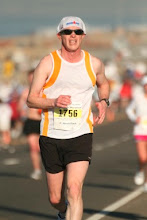
Sunday, August 29, 2021

Believing in Myself: Becoming a Real Runner

Yesterday I became a real runner.  Yes, I've been running for nearly thirty years.  Yes, I've done ten marathons, 15 Ironmans and a 100 mile ultra run.  But yesterday I truly became a real runner.  Why? Because I fully believed in myself.  Because I gave it everything I had while maintaining a solid pace at the end of a triathlon.  Even during the best runs I've done over the years, I've rarely been able to combine a full effort while maintaining my pace.  I've had many solid races that I'm proud of.  I've given it everything I've had many times.  But in almost all of those cases, my pace had slowed considerably from what I'd hoped or thought I was capable.  Something changed yesterday, and I now feel like I'm a real runner.  

So much of athletics and racing is mental.  You can do all the training in order to prepare yourself, but in the end, you have to actually execute on your training.  That's where the mental component comes into play.  For the last year or so I've transformed my run training.  I'm running 40 miles a week nearly every week.  Last year I even had a period of time where I was regularly running between 40 and 50 miles a week.  Lately, I've maintained this new volume of running while increasing my biking and swimming.  I run on a very hilly course almost every day, so it's hard to know how fast I can run on flatter ground.  I've also been running regularly at a relatively low heart rate, so it's also hard to know how fast I can run if I give it a harder effort.  Some recent race results have suggested that I've gotten faster, but nothing prepared me to have the confidence for what I did yesterday.  Now, because of what I did, I have the confidence for future races.

I'd been mentally visualizing the Santa Barbara Triathlon for a few weeks.  Most of my visualization was focused on the swim and the bike.  In some regards, I knew what I wanted to do on the run, but since the run is last, I couldn't allow myself to think too far ahead.  I needed to have a solid swim and bike first.  But once the run began, I'd figured and hoped it would all come together.  I knew that I would stay within myself for the first five miles and then give it everything I had on the way back.  I just didn't expect to be running at the pace that I found myself running at.  For years I look at the men at the top of my age group and find myself in awe of their run pace.  I've always considered them to be an echelon above me.  They are real runners.  After yesterday I can wonder if I'm close to being one of them.

When I came out of transition from the bike and started running, I looked down at my watch, to find that my run pace was close to 8:15.  In fact, I decided to back off a bit, thinking that might be too fast, and when I settled into a very comfortable (Zone 2) effort, I was still close to 8:30 pace.  The first two miles were flat and therefore really gave me a good idea of how I can run on flat ground after swimming and biking.  At the second mile, my run pace had actually dropped closer to 8:15.  This was essentially the pace I kept for the first 10 miles of a recent half marathon, before slowing down at the end. My legs felt good.  The next part was the big surprise. I had expected to slow down to between 9 and 10 minute pace on the uphill section, especially because I'd committed myself to maintaining a comfortable effort.  As I ran up the hill, I realized that my pace was still under 9 minute pace.  Hmmm.  This was going to be interesting.  By the end of the fourth mile, having completed most of the climbing, it had become clear that something was different.  I was still running comfortably and my pace was still around 8:45.  As things flattened out, I held my effort steady and found myself back at 8:30 pace at the turnaround.  Time to pick up the effort.  Over the years, this has been where I pick up the effort, but my legs don't really follow. Yesterday, they did.  And I believed that they would.

During the sixth mile, my pace dropped to just below 8 minute pace.  In March that would have been close to my pace for a 5K.  I was now halfway through a ten mile run at the end of a triathlon that would take me nearly four hours.  Where was this coming from?  The seventh mile would tell me the truth.  Running downhill should allow you to run faster, if you have the legs to do so.  I opened up my stride and just focused on running fast and hard.  My breathing picked up and for the next two miles I was running 7:36 pace.  In June I'd done a Sprint Triathlon (albeit at altitude) and my run pace was 8:10 for 5K, and I had given it my all.  

I knew that if I was going to see where my running was truly at these days that the last few miles would tell me the truth.  In some ways, my watch became my friend, and my north star.  During the 8th mile I kept my pace right at 7:36 and just did what I needed to do to maintain it.  It certainly was feeling a lot harder, but I didn't back off.  I kept up the effort and the speed.  Once the course flattened out again for the last two miles my watch was my rabbit.  I wouldn't let my speed slow beyond 8 minute pace.  I was running all out and breathing all out essentially for the last 5K of this race.  Both of my last miles were at 7:55 pace.  

After a relatively hard 1 mile swim and a very solid 2 hour bike ride, I ran ten miles at 8:12 pace.  I literally ran down 4 other guys in my age group, including the guy who won the age group two years ago. I couldn't catch the winner of my age group, but I ran 6 minutes faster than he did (he is an outstanding swimmer and put nearly 9 minutes into me on the swim).  If the course was completely flat (like Ironman California will be), I should have been able to maintain a sub 8 minute pace for ten miles.  Could I hold it for 13.1? I think so.  I should at least be able to give it a shot.  Ironman will be different, but the concepts are the same and the training is there.

In my age group, if one can run a marathon in under 4 hours you have a great shot at being on the podium and even winning the age group.  That has always been my goal, but a goal and reality are two different things.  In my mind, after yesterday's race, the idea of starting a flat Ironman run at 9 minute pace and holding it for 26.2 miles began to take shape.  I have little doubt in my mind that I could hold such a pace for twenty miles.  The rest is guts and mental fortitude.  I know I have that now, or at the very least, I'm capable of it.  I am capable of being a real runner. I believe in myself.


Saturday, August 28, 2021

Burying Myself

The Santa Barbara Long Course Triathlon is an iconic race.  Today was its 40th Anniversary.  It starts with a 1 mile ocean swim and is followed by a very hilly (nearly 2000 feet of climbing) 34 mile bike ride and culminating with a 10 mile run.  I’d looked at results from previous years and had set a goal of finishing in under 4 hours. 

My last ocean triathlon swim was at Mike & Rob’s Most Excellent Triathlon in 1994.  I did make sure I swam into the surf before the start to get my body used to the cold water and to get the feel again for swimming in the ocean.  At the start I ran into the surf with my wave and when the water was up to thigh level I leaned forward and started swimming.  It was a foggy morning, making it difficult to see the buoys and I found myself drifting a bit to the left.  I corrected my course correction and made the right turn to swim parallel to the shore.  The fog made it next to impossible to see the buoys, so I did my best to follow the other swimmers and finally got to the turn buoy with a little bit of weaving.


I had done a one mile pool swim a couple of days ago at 1:45 pace and a stroke rate of 28-29 strokes per minute (spm).  I tried to keep a similar effort, though swimming in the ocean it’s usually best to take shorter strokes.  My stroke rate was 33 spm and my pace ended up being 1:45/100 yards.  My swim time was a very respectable 30:03. 


Running up the beach and into transition might have been my first clue to the fact that I actually had “running legs.”  A solid transition time of 2:29 bespoke the fact that I’d racked my bike in the “overflow” area, causing me to run an additional 100-150m through transition compared to others in my age group.  I also had trouble getting out of my wetsuit.  I usually pride myself on my transitions, and in this case my running legs actually saved my transition time.  


I ran with my bike to the dismount line and put my right foot in the bike shoe already clipped on the pedal only to accidentally jam the heel into the back of the shoe.  Another slight delay which I fixed, got both feet in my shoes and headed out on the bike.  I was wearing an aero helmet with a visor and the fog made it a little difficult to see, but I managed to ride, albeit a little carefully.  My power meter didn’t connect, but I’m good at riding by feel, so that’s what I did.  There are three major climbs on the course and I rode comfortably to the first climb, which didn’t feel too hard.  The bike course is open to traffic and has some narrow roads, so I rode pretty carefully.  Before I knew it, I was on the second climb, and somehow I felt like I was getting my “bike legs.”  Normally, I get passed by people on climbs, but today, that literally never happened.  I was passing people throughout the bike.  The downhills, which should have been an opportunity to gain some time, required some care due to the roads and my foggy visor.  Near mile 20 I came up to a truck that was taking up the whole width of the road.  I had to slow down for a couple of miles before he finally turned off.  The third climb had a fairly steep section, but I was fine.  I rode comfortably to the end, getting out of my bike shoes shortly before the dismount and did a flying dismount.  My bike time was 1:53:47, or 18 mph.  Considering that the course had 2,000 feet of climbing, this was a very solid ride.  I had also planned to try to go into the run with good legs.  In fact, during the last few miles I began to get myself mentally ready for the run.

Again, T2 required an additional 100-150m of running, but that really wasn’t a big deal.  In fact, my time for T2 was a very solid 2:56.  I quickly put on my socks and running shoes, my hat and grabbed my race belt and ran out of transition.  


This was what I’d been both preparing and waiting for.  I’ve completely changed my run training and have been running 40 miles every week.  In fact, I’d already run 35 miles for the week and was looking forward to seeing how my run would pan out.  I started the run comfortably and looked down at my watch.  My run pace was about 8:30.  If I could just run comfortably and keep that pace, I knew I’d be in great shape.  I did the first mile in 8:34 and the second mile in 8:18, all the while feeling good.  There were hills and net elevation gain for the next two miles, and I listened to my coach’s advice and just ran easily up the hills in 8:46 and 8:50.  Mile 5 was flat and I was back to 8:34.  At the end of the fifth mile I picked up the pace and the effort, knowing that the next two miles were net downhill miles, which I ran in 7:56 and 7:36.  With three miles to go I had one more downhill and then 2 ½ miles of flat running.  This was what I’d been preparing myself more.  Mile 7 was done in 7:37 and I began to bury myself.  Literally bury myself.  I was breathing super hard and definitely suffering, but I was committed to maintaining my pace.  The lap pace on my watch during the last two miles showed 7:55 and I wouldn’t let it go up.  I held the pace while the effort increased until I crossed the finish line.  


The best part of doing triathlons with a wave start is that you start at the exact same time as your age group competitors and you all have your age on your left calf.  Shortly after starting the run I passed someone in my age group.  After the turnaround I came up to three more guys in my age group over the next couple of miles.  As I came up behind each of them it was obvious that I was running faster than they were.  Nevertheless, after settling in behind them for about 5-10 seconds, I surged past each of them, quickly putting 20 yards between us.  They couldn’t respond.  In the past, that would have been me.  In the end, I put an additional 8 minutes on the first three and two minutes on the last guy.  It turns out that he won the age group two years ago.  


My final time was 3:50:00, ten minutes faster than my goal and pretty close to as fast as I thought I’d be able to go.  This time put me 2nd in my age group.  It turns out that the winner of my age group lives in Santa Barbara and is an excellent swimmer.  When I came out of T1 I was 9 minutes behind him.  At the finish line, I was 2 ½ minutes behind.  Three more miles…


In eight weeks I’ll be toeing the line at Ironman California.  I’m looking forward to finding out how my run holds up for 26.2 miles.

Saturday, August 7, 2021

Crushing It!

I’ve never been particularly fast.  Considering I didn’t even run a mile without stopping until I was 32, my legs never really understood speed.  For the past two weeks I’ve been visualizing the sprint triathlon that I did today.  The Pasadena Triathlon is a “reverse” sprint triathlon, meaning that the order of events is run, bike and then swim.  What is most notable is that I did this race for the first time in 1993, when it was only my third triathlon.  Today would be my 98th triathlon since my first race in 1992.  Ironically, that one, in Cerritos, also followed the “reverse” format.  My training lately has been devoid of speed and focused solely on my Ironman coming up in October.  Running fast, and even biking super hard, are not things that I’ve been practicing.  Which means that my mind isn’t used to the feeling of essentially going all out for an hour.  That was the goal.  And, to that end, I’d been visualizing this race every day and night for the past two weeks.  
 
It was my plan to run the 5K as if it were a 5K race, though not quite to the point of feeling like I needed to throw up or pass out at the finish.  The next part was the unknown, although I had a sense that I could race the bike as hard as I could, literally turning the run-bike combination into a 10K run, which is a painful experience.  Obviously, at the end of all of this was a 150m swim, which never concerned me.  
 
The course was a 5K loop around the Rose Bowl in Pasadena, the first half of the loop being a gradual uphill and the second half a gradual downhill.  The bike was three laps of the same loop.  After the bike, there was a 400m run to the Olympic distance pool, where we would complete three lengths.  
 
I warmed up by running about 2 ½ miles prior to the race.  The crazy part is that during my warm-up picking up the pace to what I planned to do felt hard.  Truly, my brain is not used to running fast.  I started with the first group, planning to finish the race in under one hour. The record for the course was right around 49 minutes.  Anything one hour or better would definitely represent a seriously strong effort. From the start, I went out fast, starting at under 7 minute per mile pace, but gradually “settled into” a hard effort/pace that led to a first mile (which was uphill) of 7:40.  Check.  That was exactly what I’d planned to do.  I was breathing every third step, and it felt hard, but it also felt like I could hold the pace.  I was looking forward to getting to the halfway point, where the course started going slightly downhill.  Before I knew it, I had finished my second mile in 7:33.  Check.  With one mile to go, I really focused on going fast, and literally allowing myself to suffer.  My breathing was still hard, and I even allowed myself a quiet “grunt,” which has long been my trademark.  As I looked down at my watch during the third mile, I realized that I was keeping close to 7:15 pace.  It was hard but knowing that I was still going fast gave me the encouragement that I needed to keep pushing hard.  I hit the third mile in 7:12 and realized that the course was going to be a bit longer than 5K.  That was ok, I could still push hard through transition.  My 5K time was actually 23:13, which remarkably is the fastest 5K I’ve done in several years.  And I still had to bike!  My time arriving in transition for the run was 24:32 (7:28 pace), which was 76thoverall. I ran to my bike, kicked off my running shoes, hat and my race belt (which I fumbled with a bit), and put on my helmet, grabbed my bike and made my way out of transition to the mount line. Transition took me 50 seconds, which was solid (45th overall).  
 
I had my bike shoes on my bike and got my right foot in, pushed off a few times an put my left foot on top of my left shoe.  There was a “no passing” lane for a bit, so I couldn’t go fast, and it allowed me to reach down and put my left foot in my shoe and tighten both shoes.  I turned on the bike portion of my garmin watch and got to the beginning of the first loop.  From that moment to the time I got to the end of the third loop I just pushed a hard as I could.  I figured that I’d learn the course during the first lap, which I did.  The first part of the loop was uphill, and I just put my head down and buried myself with a hard effort. The second part had some downhill and an opportunity to keep pushing and hold some speed.  
 
There were two take home lessons from the bike.  The first was that I went out hard and managed to maintain the same hard effort during the second loop, and then repeat it a third time knowing that I would be done shortly thereafter.  Considering that I’d just done a nearly all out 5.3K run, the bike effort definitely “hurt.”  But, I ignored the discomfort and just powered through, knowing that it would be over soon enough.
 
The second lesson was that there were a lot of triathlon “newbies” in the race.  The first lap was fine, as I was passing fairly solid athletes, but the second and third loops was like riding in an obstacle course.  People riding 10mph on the left, and when I yelled, “on your left” at the top of my lungs, they either didn’t move, moved to the right, or, worse yet, moved to the left.  This clearly caused me to slow a little at times, but I planned ahead with each person I was passing and it only got dicey a couple of times.  I even passed someone who was riding on the left side of the road and talking on a cell phone!  Before I new it, I was finishing the third loop.  I think the person who was at the turnoff thought I had another lap to go, probably surprised by the grey hair and finishing so soon!  My normalized Power on the first lap was 190 watts and my speed was 20.4 mph; the second lap was 197 watts and 21.4 mph and the third lap was 193 watts and 21.4 mph.  My bike time was 28:38, which was 31st overall.  I got out of my bike shoes shortly before the bike finish and did my usual flying dismount, racked my bike, took off my helmet, my glasses and socks and quickly put on my running shoes and swim cap and grabbed my swim goggles.  The run to the pool was about 400m and that was included in our second transition time, which was 2:56.  I was 118th overall with this time.  In retrospect, perhaps running in bare feet and forgoing the swim cap might have save me some time.  Oh well.  Just before the pool entrance I kicked off my shoes and put on my goggles.
 
I got to the pool, jumped in and started swimming.  In a lot of ways, this was the easiest part of the race.  I was definitely winded, but my swim speed is pretty solid to begin with if I’m not going all out.  I went fairly hard, passed a few people (not too many in the pool yet, thankfully), and was soon at the final 50m.  I had visualized picking up my pace and my arm turnover, which I kind of did, but there wasn’t too much left in the tank at that point.  My swim time was 2:59 for the 150m (1:50/100 yard pace), and my official swim time (which included getting out of the water and walking past the timing mat, was 3:38 (67th overall).  I kept 29 strokes per minute, which means I was working.  I was definitely winded at the end but finishing with the swim was somewhat of a godsend, allowing me to “cool down” somewhat at the end.  
 
My final time of 1:00:32 was slightly over the one hour I had hoped to finish in, but that had been assuming a 5K run and not 5.3K.  I pretty much did everything that I’d set out to do.  I suffered for an hour straight in a way that I’m not sure I’ve suffered before.  I kept pushing the entire time in a way that I don’t think I’ve ever pushed in terms of maintaining both effort and pace on the run and bike.  I was 40th overall out of 578 people.  I won my age group by nearly 6 minutes.  I’ve never been “that guy,” but it felt good.  I do have to note that there were two 65 year old guys that beat me by a minute, both of them actually managed the transitions better than me and were clearly at the top of their age group.
 
When all was said and done, I felt like I’d executed almost flawlessly, left everything out there on the course, and literally “crushed it” today.  Two age group Sprint wins in a row feels pretty good.  

Monday, July 19, 2021

Racing Again!

 I did my first triathlon since Kona three weeks ago and didn’t write my race report due to traveling and then a nasty two week period of time that included a tooth extraction.  Yesterday, I raced a half marathon.  I figure it’s a good time to write about both races. 

First, the sprint triathlon was the Boulder Sunrise Triathlon.  It followed the same course that I had raced many times when I lived in Colorado, starting at the Boulder reservoir and biking up Jay Road to 36 and running in the reservoir.  Leading up to the race we gradually acclimatized to the altitude, first by spending three days in St. George, Utah (2700 feet).  While in St. George, I ran one loop of the Ironman run course and did some biking.  I also stopped thinking about work and COVID-19 (as best I could). We then went to Glenwood Springs (~5700 feet) for three more days, where I ran some more.  Finally, we spent two days in Silverthorne, Colorado (8700 feet), where I biked and ran.  The great part was that I never really felt stressed by the altitude.  It may have helped that my overall stress level was significantly decreased.  Then, on to Denver for a week prior to the race.  While in Denver I continued training, both running and biking.  My favorite day of running was running 13.1 miles and feeling like I hadn’t even run later that day and the next day.  My resting heart rate was the lowest it’d been in a couple of years, demonstrating my fitness level.  I didn’t really back off training for the race, since I’m really focused on training for Ironman California in October.  


Race day came and I rode my bike to the Boulder Reservoir (I love the venue!).  It was exciting to be racing again and I actually ran into someone in my age group who remembered me from when I lived in Colorado!  My friend Rudy came to cheer me on (always a challenge in a triathlon).  I’d forgotten that for sprint triathlons there is no specific spot for one’s bike, so I tried to find a spot close to the end so it wasn’t too crowded.  It was fun getting everything set up.  Transitions are one of my favorite aspects of a triathlon and I pride myself on quick transitions.  Since this was a spring, I wouldn’t need socks and I could put my shoes on the bike.  While apparently we weren’t allowed to warm up in the water, I managed to get in for a few minutes and get a few strokes in.  When our wave (finally, a wave start again) was to start, I waded in the water and moved to the front, as I usually do.  From the start I went out relatively quickly, got knocked around a little and settled into a smooth rhythm.  I didn’t feel particularly fast, and focused on sighting the buoys.  The swim was over pretty quickly (~16 minutes of time in the water).  The swim was presumably 750m, my garmin said I’d swam 867 yards at a 1:53 pace.  Considering I was wearing a wetsuit, not particularly fast for a sprint race, and a few minutes slower than my typical swim times in previous races in the reservoir over a decade ago (although all of the times for the other swimmers were also a few minutes slower, so I assume the course was a little long).  I stopped on the grass and took off my wetsuit, jogged into transition, got to my bike, threw down my swim cap, goggles and wetsuit, put on my sunglasses and helmet and grabbed my bike. I got to the “mount” line and put my foot in my right shoe, pushed off a few times and put my left foot on top of my left shoe, peddled a bit and put my foot in the shoe, tightened both shoes and headed out of the reservoir.  


I’d done this route many, many times, and I was determined to give it a solid effort.  I did!  In fact, for the first five miles, which consists of a “false flat” uphill (gaining 330 feet of elevation), I managed to keep my power ~195 watts and my speed at 18 mph.  I’m pretty sure that those are numbers that I hadn’t held in a long time.  The next part of the bike, the next five miles, are always fun, as there is an elevation loss of about 200 feet, with a few short climbs that can be “flattened” by good planning and effort.  I managed to keep my power ~195 watts and my speed on this part was 26 mph.  The next part of the course has some ups and downs and has no net elevation change, although the rollers need to be managed to maintain speed.  My wattage dropped a little to ~185 watts, and my speed was 23 mph.  I tried to relax a little and back off the effort for the last couple of miles, which had me maintaining wattage of 170 watts and a speed close to 23 mph.  As I turned into the reservoir, I got out of my bike shoes, putting my feet on top of my shoes, and only braked right near the dismount line, doing a flying dismount.  My friend Rudy didn’t know what my helmet our tri-suit looked like and didn’t realize that I’d dismounted.  In fact, he later remembered seeing someone flying to the dismount line who “looked like a pro.”  That was me.  In fact, I’d passed a bunch of people on the bike and was one of the early people into the transition.  Turns out only about a dozen people rode faster than I did.  My bike time (from my garmin) was just under 47 minutes.  My “normalized” power was ~190 watts and my average speed was ~22 mph.  Solid!  I racked my bike, took off my helmet, sat down and put on my shoes, hat and race number and was out of transition in just over a minute.  Onto the run. 


During the bike, I was playing leapfrog with a 71 year old, Steve Bell.  He came into transition just ahead of me and started the run about 10 yards ahead of me.  I was never able to catch him, but the distance between us never changed!  I had set myself to start the run comfortably for the first 400m, and the crest of a hill and then get into my run rhythm and pace.  Which is exactly what I did.  My first mile was at 8:14 pace.  I let the effort get harder as I went along, and it did, but I was able to maintain my pace at 8:11.  I had planned to push harder over the last mile, which I did, breathing every third step and keeping my pace right at 8:09.  Six hundred meters from the finish I realized that the person ahead of me was in my age group.  He was tall and lanky, and I assumed he was pretty good.  I didn’t want to get into a sprint finish with him so I came up behind him with about 500m to go and slowed down a bit and relaxed for about 100m.  When we hit the crest of the hill (the rest of the way was mostly downhill), I sped past him and put about 20 yard between us in a very brief period of time.  He certainly didn’t have the energy to stay with me, and I continued as fast as I could to the finish, hitting the finish line with a pace over the last few hundred meters of 7:12.  


It turned out that that last surge got me first place in my age group, making this race one of the more exciting ones I’d ever done.  I was 29th overall, and realized that my bike and run splits were close to my best times over a decade ago.  At the age of 62, I’ll take that every day of the week!


I went back to our hotel, showered and then we drove home over the next two and a half days.  Two days after I got home I went to the dentist to get a temporary crown on a broken 3rd molar.  It didn’t take well and I spent the 4th of July weekend in agonizing pain.  When I saw my dentist on Monday he immediately said that the tooth needed to come out.  He put me on antibiotics, and the next day I had the tooth extracted.  Six more days of significant pain finally got me to the point where I could run again, so I went into last week with some training to “make up.”  I had a half marathon that I wanted to race.  I had no clue how it would go, I’d done no speed training, and I was significantly fatigued from all of the pain.  Nevertheless, I ran 8 miles every day for four days, ran another four miles on Friday and did a solid 3 mile run on Saturday.  The solid 3 mile run was probably a little harder than it needed to be or should have been, but I wanted to “test” myself.  I also biked a few times during the week, including a ride on Saturday afternoon.  


Sunday morning found me feeling only “ok” when I woke up.  My resting heart rate wasn’t the best, but it wasn’t bad.  I felt a little sluggish, but knew that once I got going I’d be ok.  I drove to the race venue, parked, and ran 1 mile to the start, keeping my HR below 130.  My pace was right around 9:30, which was good.  My coach had suggested that I start out easy for the first mile, but I decided to “test” myself, an went out with the 1:40 pace group.  The temperature was 65 degrees, but the humidity was ~80%.  The pace (7:37) was a little on my limit, but I let them move a little ahead on the slight climbs and came back to them on the downhills for the first two miles which I did in 7:36 and 7:45 respectively.  My HR had come up to ~160 and I didn’t want it higher, so I realized that I should back off, which I did.  The next six miles were done at 8:09, 8:16, 8:22, 8:26, 8:27 and 8:22 pace.  I had stopped looking at my HR, which actually dropped down into the 150’s. After the turnaround I tried to pick up my effort, but my body wasn’t really responding too well.  Of note, my 10K time was right at 50 minutes (8:08) pace, which would have been solid on its own, much less than during the first half of a half marathon.  I tried to push harder the last 5 miles, but all I could manage was 8:41, 8:58, 8:51, 9:02 and 9:16.  The 1:50 pacer passed me with a little more than I mile to go, but I couldn’t stay with him.  I tried. It turns out that my HR did show my attempt to push, as it went up over the last mile and a half, getting back to ~170 at the finish.  My average pace was 8:28 (1:51:11), and I ended up 4th in my age group, just a couple of minutes out of 2nd.


In retrospect, if I’d started at 8:20 pace, I have little doubt that I could have broken 1:50, and possibly ended up second in my age group.  However, that’s not consistent with my approach of testing myself.  I really wanted to see what I could do.  I had some speed in me, but haven’t really trained to hold it.  Nevertheless, I was very happy with my result and the fact that I kept right at 8:20 pace for 10 miles (83 minutes).  Even when it got hard at the end, I managed to maintain a pace close to 9 minutes.  From my Ironman perspective, that’s really good to know.


It was humid, and I only stopped for water (we had to bring our own cups) three or four times.  I probably lost about 5 pounds during the racer, but aside from my shirt being soaked and my hands looking like prunes, I actually felt ok.  A really good experience, and a lot of fun racing again!

Saturday, March 27, 2021

Defining Moments: My Sixth Decade

My sixth decade is a collage of my entire life  Work and my workaholic tendencies, exercise and athletics and my determination to get to the Kona Ironman, dedication to my children, my continual mission to seek out purpose, an particularly find purpose in helping older adults.  My sixth decade touched all the bases, though ironically was bracketed by my workaholism and drive for purpose.

Just prior to my 50th birthday, I had a PR at the Eagleman Half Ironman.  My training was going great in preparation for the Long Course World Championships in Perth, Australia  I felt like I was in the best shape of my life  At the same time, work was as busy as ever, which  meant I was going a mile a minute every day.  We'd had some inquiries from a hospitalist company about our practice, but I ignored them.  Still, there were actually a lot of stresses at work, as my business partner and I seemed to have more and more conflict on a regular basis.  And, then, in the summer of 2009, was Little Blossom  The previous winter, my daughters had written a couple of scripts for a television pilot and myth wife and I thought it's be "fun" to let them actually produce it.  I'd had a recent business success with a company called Common Sense Medical Management, and thought we could put the money to good use  In many ways, this endeavor had far reaching tentacles that would go on for the next decade.  My wife and daughters did all of the work preparing for the week of filming that was planned in August  I had decided to take a week's "vacation" to help out, but also "rest up" for the Boulder Half Ironman that was literally at the end our week of filming.  to this day, that week was one of the most stressful and hectic weeks of my life  Not a good way to taper for a race.  In fact, I got zero training, minimal sleep and tons of stress.  But, like everything in life, I learned a lot of lessons, and hopefully, so did my daughters.  My wife, on the other hand, pretty much hated the whole experience  But she did it for our kids, and she did brilliantly at that!  The most notable parts of the week were the extreme pride I had in my daughters and what they'd accomplished, and the point at which I'd pushed myself to a mental breakdown the day before my race.  The race itself became anticlimactic, but I was super proud of how I did considering that I persevered despite the incredible odds.

Senior Care of Colorado, the private practice I had co-founded in 2001, was growing  We were getting bigger and more complex.  We were negotiating for more business.  My business partner and I would disagree over how much time we should spend running the business rather than working in it.  My stress was building.  In October of 2009, my family left for a three week vacation to Australia and New Zealand.  The first part of the vacation had me splitting up to race at the Long Course World Championship in Perth, while my wife, two daughters, and 85 year old father in law vacationed on the other side of Australia for a few days.  I was excited.  I was in the best shape of my life and wanted to see how I might compete against the best in the world in my age group.  My swim was uneventful.  But, just a half of a mile into the bike ride, I got too close to the left curb and crashed, sliding along the side of the road for about 30 feet.  My bike was ok, and with crowds yelling "go USA," I got back on my bike to complete the 48 mile bike ride.  My flying dismount caused me to land on my left foot and the searing pain in my left hip sent me to the medical tent, where I was told that, at the very least, I had a separated shoulder.  They couldn't figure out what was wrong with my hip.  3 1/2 miles later, I shuffled back to the medical tent and nearly passed out.  A trip to the hospital led to a diagnosis of a fractured clavicle and an "irregularity" in my left hip.  Three weeks later, a CT scan showed a fracture of my left hip socket and pelvis.  Ironman St. George was still six months away, and I was determined to do my first ironman.

I took the accident as a signal that it was time for me to slow down.  I actually tried to do that in regards to work, which only increased the stress that I had with my business partner.  In the spring, IPC reached out and asked us what it would take to acquire our practice.  My CFO and I sat down and came up with a number.  As I was getting on a plane, coming back from the 2010 annual meeting of the American Geriatrics Society, we got the response.  They were going to give us what we wanted!  Over the next six months, I experienced what it was like to sell a business to a publicly traded company.  Only a few of us could know, which made many of my actions and decisions appear to be nonsensical.  In December of 2010, I sold my business and spent the next year and a half working part-time.  In many ways, it was one of the best times of my life.  I got to focus on my Ironman training and my family.  "Unfortunately," one of my ways of focusing on my family led me to invest in an entertainment internet business, GeekNation.  In the end, it wasn't a good business investment, and it turned our lives upside down, leading us to move back to California in 2012, which coincided with my retirement from clinical practice.  I was going to focus on my wife and training, but instead got neck deep in a new business.  There were many lessons from that business, but the most important was that I had no business in the entertainment business.

All the while, my sixth decade was my Ironman decade.  Over the course of ten years, I completed 14 Ironman races, and nine half ironman races.  I thus qualified for Kona through the Legacy program.  My first ironman was at St George in 2010, and I've written race reports for every one of the following races:

2010 St. George  13:18:26  (40/122 AG)

2011 St. George  12:45:54 (29/105 AG)

2012 St. George   13:52:21 (24/110 AG)

2013 Lake Tahoe  14:27:28 (72/161 AG)

2014 New Zealand 12:17:00 (22/92 AG)

2014 Boulder 12:34:19 (15/92 AG)

2014 Chattanooga 11:31:59 (11/103 AG) (PR)

2015 Boulder 13:07:15 (22/77 AG)

2016 Boulder 12:19:58 (6th/53 AG)

2016 Chattanooga 12:32:59 (10th/112 AG)

2017 Boulder 12:58:57 (10/63 AG)

2017 Santa Rosa 12:26:51 (23/105 AG)

2018 Santa Rosa 14:52 (52/92 AG)

2019 Boulder 12:46 (7/30 AG)
In 2014, I achieved Gold status as one of the top people in my age group in the world.  I was 34th in the world and 9th in the U.S.  My first Ironman in my new 60-64 age group in Boulder in 2019 garnered me my second highest placement in an Ironman, missing the podium by two spots.

"Retirement" lasted a few years, before a chance meeting got me to take a job running the nursing home arm of California's quality improvement organization.  I actually had a lot of fun for about a year and a half, working with a great group of people, until it wasn't fun.  As soon as the fun ended, I left.  Shortly thereafter, I was asked to become the Chief Medical Officer of the largest nursing home chain in California.  I didn't think that CMOs had any authority or clout, and said so, but I took the part-time job anyway.  It was fun again.  Eight months into the position, in August of 2017, I received a phone call asking if I'd be interested in becoming the CEO.  My life was about to change yet again.  The next fourteen months were the business and hardest of my life.  In a story that has started to be told in the media over the past year, I lasted 14 months before resigning.  Like every decision in life, I learned a lot from this experience.

Shortly after resigning, I completed my first ultra marathon, the Snowdrop 100, with my good friend Robert Key, and upon recovering from that began my preparation for Kona.  Part of that preparation was the decision to compete in the 2019 Ironman Boulder, which ironically turned out to be one of my best Ironman races ever from a placement perspective.  It was also just a week before my 60th birthday, and the beginning of my 7th decade. 

Friday, March 26, 2021

Defining Moments: My Fifth Decade

My father used to quote a saying that my grandfather, Morris Wasserman, was fond of.  It had to do with sacrificing one's health in order to gain wealth, and then using that wealth to try to regain one's health.  In my fifth decade, I put that saying to the test, with the addition of trying to achieve purpose all wrapped up in the middle of it!

My fifth decade began in the summer of 1999, as I continued to "commute" between Denver and Central Florida every week.  I'd leave the house on Sunday afternoon, get on an airplane and fly to Orlando, arriving past midnight and heading to the Hilton in Altamonte Springs.  On Thursday afternoon, I'd fly back to Denver.  On Friday, I saw patients in the clinic.  My daughters were 12 and 8, and it's a wonder that they knew who I was.  I was the President and Chief Medical Officer for GeriMed of America and I was trying to prove a point about primary care geriatrics and make a difference in the world.  In many ways the world wasn't ready.  Nevertheless, our business in Central Florida had expanded from Orlando to include Daytona and Tampa, and we were profitable.  We had "full-risk" contracts with Humana and Cigna. I was constantly battling these HMOs, as well as the hospital systems and other market forces.  Primary care geriatrics was a profitable business model.

I remember once considering getting an MBA, only to realize that I'd gotten an MBA in the real world of health care business.  I had some of the best mentors.  Jim Riopelle, my boss, was one of the early pioneers in managed care and accepting risk.  Ray Delisle was our Chief Operating Officer.  In his previous role as VP of Human Resources for Samsonite, Ray knew more about HR than anyone I've ever met.  He'd also had extensive experience negotiating with unions.  And he was my friend.  Very few days pass where I don't think of one of Ray's colloquialisms.  And Jim, well, you had to really know him to love him. I miss both Jim and Ray as I write this, but they'll both always be looking over my shoulders and helping me along.  

Unfortunately, while we had been successful in Florida, our Denver operations were losing money.  In many ways, it wasn't surprising.  Our Denver clinics took care of the most frail patients and there was no such thing as "risk adjustment."  We actually were profitable when it came to specialist costs, but we had still lost nearly a million dollars due to excessive hospital costs.  As President of the company, I had no choice but to shut down our Denver operations.  In the winter of 2000, I was driving home from the office and my colleague, Don Murphy, called me.  He had decided to take over his clinic and turn it into a fee-for-service private practice.  Was I interested?  I was still President of GeriMed and all of my business was about to be in Florida.  Did I really want to continue commuting to Florida every week?  I was intrigued.  And, like every major decision in my life, I immediately knew the answer.  By the time I got home I told my wife that I was going to resign and go into private practice with Don.  On January 1st, 2001, Senior Care of Colorado was born.

I need to back up to some personal stuff first.  I had herniated my L5-S1 in 1998 and had really gotten off track from my marathon running and triathlon training.  In fact, I'd gained almost 20 lbs.  My dad underwent a Bypass and aneurysm repair in May and August of 2000, an I remember thinking, I need to focus on my health.  It was time to get back in shape and reset my ironman goal that I had postponed.  My new goal for to do an ironman when I turned 50.  First, I had to build up and get back in shape.  It took me a couple of years, but I did my first half marathon and first triathlon of the new millennium in 2003.  

My fifth decade was consumed by work and training.  Owning a business is a 24/7 commitment.  In 2016 Springer published my book, "The Business of Geriatrics," which tells a lot about my fifth decade.  There's so much.  Starting a business with a partner, taking on a second partner, divorcing the second partner, going $1.5 million in debt, figuring it out, hiring a CEO, firing a CEO, hiring my old CFO from GeriMed despite the fact that we had never gotten along, and now he's a lifelong friend, fighting with my business partner, battling the marketplace, being investigated by the OIG for most of the decade, it just doesn't end.  Missing my kids growing up.

I hired a coach in 2005 (and after 16 years he's still my coach!).  My half marathon times tell the story:

2003 (Denver) 2:00:37

2004 (Denver) 1:50:10

2005 (Denver) 1:39:33

2006 (Surf City) 1:37:14

2006 (Denver) 1:43:15

2007 (Surf City) 1:32:25 (PR)

2007 (Denver) 1:43:38

2009 (Surf City) 1:33:54


So do my half ironman times:

2004 (CA) 6:08:04

2005 (CA) 5:49:56

2005 (CO) 5:29:05

2006 (CO) 5:18:39

2006 (CO)-Harvest Moon 5:24:34

2007 (CA) 5:13:07

2007 (CO)-Harvest Moon 5:34:22

2007 (CO) 5430 5:07:24

2008 Halfmax Nationals 5:43

2009 (CA) 5:19:36

2009 (Eagleman) 5:02:44 (PR)


Of note, the 2008 Halfmax Nationals qualified me for the Long Course Triathlon World Championships in Perth, Australia in 2009, but that's my next decade, so it will have to wait.  I also ran my fastest 5K ever, and my only 5K under 20 minutes on my 49th birthday in 2008.  As I got close to turning fifty, my ironman dream was in the making, but my life was also careening in terms of work:life balance.  That would ultimately define my sixth decade.


Sunday, March 21, 2021

Defining Moments: My Fourth Decade

Looking back I realize how much happened during my fourth decade of life.  I started my first full-time job as a physician in July of 1989 at Kaiser-Permanente in Woodland Hills.  I would work at Kaiser for the next five years, before moving my family to Colorado to open up a hospital based senior clinic for GeriMed of America.  By the time my fourth decade came to a close in June of 1999, I was the President and Chief Medical Officer for GeriMed of America and was literally commuting between Denver and Central Florida every week. 

The most important thing that I did prior to starting my job with Kaiser was preparing to start the job.  A friend had warned me that if I didn't prepare in advance the system would suck me in and I'd never get rolling.  So, I planned ahead, and on my first day, Kaiser Permanente's first outpatient geriatric consultation clinic saw its first patient.  Over the next five years, I would accomplish a lot, which meant of course, that my workaholic life was starting.  My wife often reminds me of how it seemed that I was never not working during my time at Kaiser.  She was correct.  Not only did our clinic quickly get busy, but I started getting involved in just about anything and everything associated with the organization.  Thirty years later I spoke to a colleague who had a similar experience, and found that we were both doing the work of a few people.  This led to accolades and a one week trip to Hawaii, where I consulted with the Hawaii Kaiser-Permanente in regards to their geriatrics programs and care of older adults.

In the summer of 1994, six months after the Northridge earthquake, I was named co-chief of Kaiser's second Department of Continuing Care.  Two weeks later, I gave notice.  It turned out that at that year's annual meeting of the American Geriatrics Society, I had met Dr. Steve Phillips, who introduced me to Jim Riopelle.  Jim was an emergency room physician who had bought a company called GeriMed of America and was looking for geriatricians to come work for him.  At the time, despite having my own department at Kaiser, I knew that I was still just one geriatrician in an organization that had its own bureaucracy.  Jim was an entrepreneur, and something just clicked.  He would become my boss, my mentor, and a friend.  He died this past winter, and while he was a self-described asshole, he was still my friend.  

GeriMed of America was a new phase in my life, and the decision to move my family to Denver was certainly a big one!  In fact, we were living with my in-laws at the time due to construction on our house from the earthquake.  For the next couple of years, I was basically a practicing geriatrician, seeing my patients in the clinic, the hospital and the nursing home.  GeriMed was growing, and needed a President, and I wanted to be that person.  Ironically, the annual meeting of the American Geriatrics Society in 1997 was going to prove to be instrumental in yet another major change in my life.  A colleague, David Polakoff, told me about some clinics in Florida that his nursing home company was looking to sell.  They were in a full-risk contract with Humana and they were losing a lot of money.  Before I knew it, I had initiated GeriMed's first major acquisition and shortly thereafter began my weekly commute to Florida.  

Every Sunday night I'd get on an airplane to Florida, and every Thursday night I'd fly home to Denver.  On Friday, I was in the clinic seeing patients.  I racked up a lot of frequent flyer miles over the next three years.  I also had started running in 1991 and did my first marathon shortly after the Northridge earthquake in 1994.  I did my first triathlon in 1992 and dreamt of building up to the ironman distance by the time I turned forty.  However, by that time, I was commuting to Florida and running a healthcare company. Ironman would have to wait.  That didn't keep me from running, which became my major form of exercise, and I managed to do several marathons, my fastest being in 1997 in Philadelphia.  I managed to time that race with a geriatrics meeting, and will always remember two of my best geriatrician friends, Cheryl Phillips and Jim Lett cheering me on at the halfway point of the race. 

As my fourth decade came to a close, I didn't realize that I was about to embark on another journey in a year and a half.  In fact, I thought that I had reached a pinnacle, as president and chief medical officer of a geriatrics medical management company.  In retrospect, I learned a lot from acquiring a business and building it over three years.  We acquired four clinics from Mariner Health in Orlando, Florida.  Within a couple of years, we had ten clinics from Daytona down to Tampa.  I was running the company from Florida, which meant that I wasn't home very often.  That was going to change within the next couple of years.